Hello welcome to my Blog

Mezze is widely served in the Greek and Middle eastern world. An assortment of little dishes and tasters which accompany a nice ouzo or a glass of wine. So when you read mezze moments you will have tasty snippets of life as I live it, India for four years and now Brisbane Australia, all served up with some Greek fervour and passion.

Search This Blog

Wednesday, 17 August 2011

Shrinagar

Shrinagar  (Sri- rich /abundance  Nagar- a Town)  is the capital of Kashmir and it has clearly been a favourite destination for Moghuls, Britishers and anyone who has a love of nature and beauty. The Moghuls thought of it as a place for rest and relaxation and somewhere to take the Begums - so they planned and planted the most beautiful gardens for them to enjoy.Modern day husbands can take a leaf out of that book.
There are several  gardens worth visiting - Chashma Shahi (the royal fountains); Pari Mahal (the palace of the fairies); Nishat Bagh (the garden of spring); Shalimar Bagh; and the Naseem Bagh. The Tulip Gardens have been recently opened to public by Sonia Gandhi.
The attention to order and linear form is strangely comforting and the variety, colour and fragrance is wonderfuly enticing. Unlike in a lot of places in India where the Moghuls designed their char baghs the waterworks here are kept in good order and the soothing sound of water flowing is the only audible noise.
The Shalimar Gardens
Take a walk - I would say in any season- when we were there the dhalias were out in their full glory. I said we must return in the autumn to catch the changing leaves of the Chinar tree which is the tree of the area, a type of plane, tall, with a huge base, wonderful leafy foliage and characteristic of the area.

 The Nishat Gardens
 The Pari Mahal on the hillside overlooking the town
The town is an interesting mix of very old and beautiful wooden buildings and lots of bakeries selling kashmiri breads and sweets. The bazaar is buzzing and the people, oh the people, they are so very handsome and welcoming it is hard to leave.


Monday, 15 August 2011

Indian Independence Day 2011 and some snake charm

Its the 15th of August 2011 and India's Independence Day. I was busy catching up on emails and sorting out paperwork at my desk.Holidays are good days for catching up on such things, since we chose not to go to the Red Fort in the pouring rain. I got up to tidy away some box files that had been on the floor for a while.
As I was ready to pick them up a snake slithered from out of one, a foot long, grey-green with a forked tongue. I called my Knights in shining armour who arrived armed with barbeque tongs and gardening gloves and between them Charles managed to pick it up gently behind the head while Anthony held it down and they took it out into the garden where we released it.

To be absolutely honest I was a little freaked by it all.
Hope this indicates a madness of good luck and fortune on this auspicious Independence Day for India.

Sunday, 14 August 2011

Kashmir - where beauty pays a price

Most Europeans would not entertain the idea of visiting Kashmir. Last year there were quite a lot of disturbances there and for years it has been plagued by the unhappy politics being played out by India and Pakistan. I ask myself whether this is this the price you pay when there is so much beauty as everyone wants a part of it?
Kashmir was in the hands of a Hindu Maharaja at the time of Independence but it always had a large Muslim population. At Independence there was an expectation that it would go to Pakistan but in fact the Maharaja signed the Instrument of Accession which was accepted by the Indian government. The resulting war in 1947 produced a divided state where India claims the majority of it but there is also Azad Kashmir administered by Pakistan and Aksai Kashmir administered by China. Throughout the years disputes, militancy and armies have kept this region on the edge and its people have suffered endless hardship and injustices.
I cannot lie- the military presence was everywhere. Barbed wire fences, sand bags, barricades, smart and large Indian soldiers wielding weapons and impressive army establishments like the High Altitude Warfare Institute are all around you.
 Our balcony on the houseboat
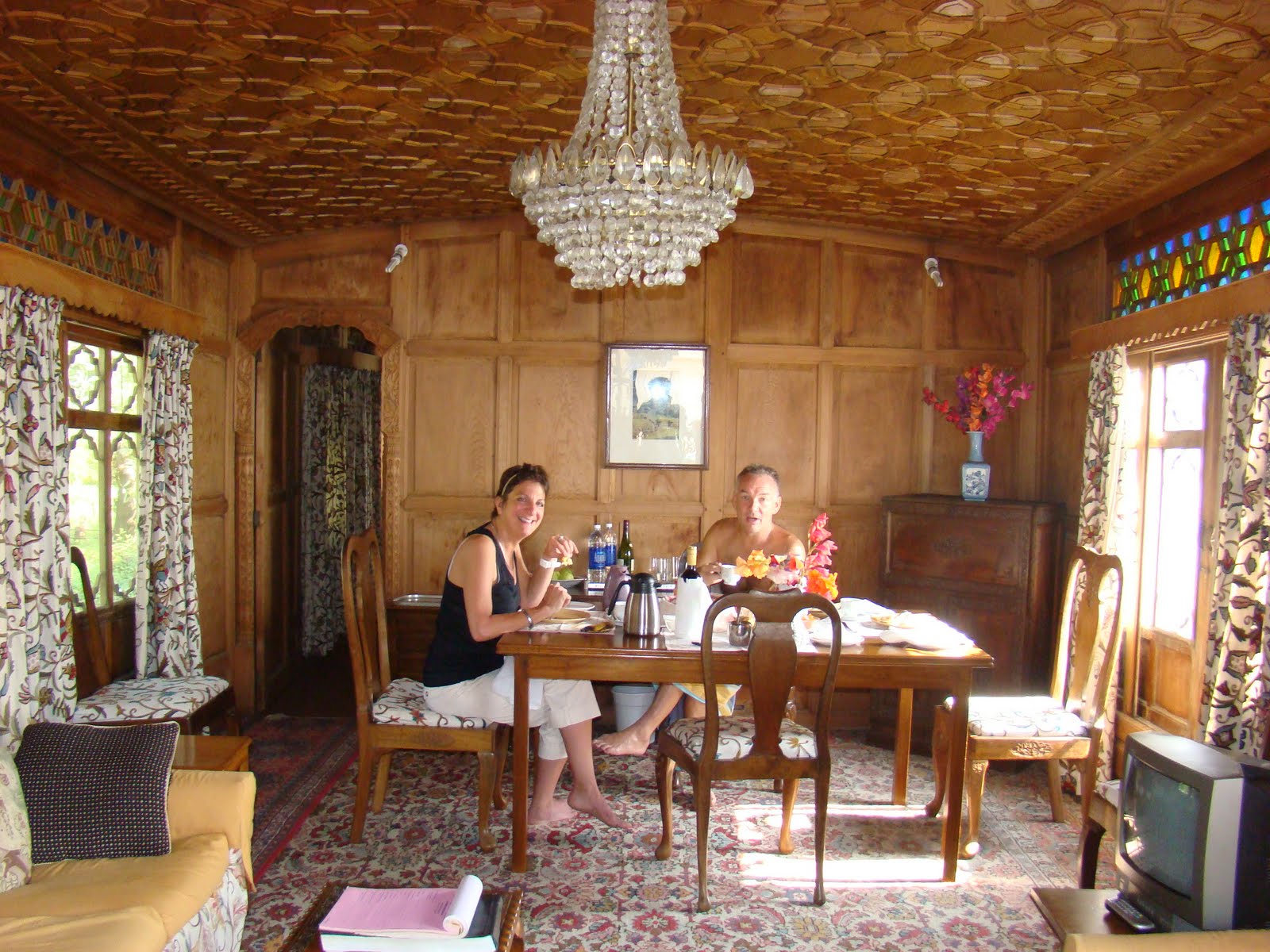
The dining and sitting room
 
Typical Housboats

 
 The bird life is right there in front of you swooping and singing all day long

All the more reason to say enough - these handsome people should not suffer any more and need to be supported to promote the beauty of their country and the two or indeed three dominating countries have to find a peaceful way forward. I will not lose sleep over this or hold my breath but feel I need to say it as I come from a divided country too- probably the last in Europe and half my homeland is under occupation 37 years since it was invaded by the Turkish army but I still hope that one day there will be a settlement which will allow us to live and prosper, side by side, in our own beautiful land.
So we visited Kashmir and it was truly magnificently beautiful and strangely one of the most peaceful places I have been to in India. Shrinagar is the capital of the state and we stayed on a houseboat on Dal Lake. As often when I am faced with new situations I question how things came to be- who started the tradition of houseboats and why. Part of it was the reluctance of the Maharaja to allow anyone to own land and the increasing desire of the Britishers to spend time in this cool paradise. Doonga boats were introduced to house them and they eventually lead to the sophisticated, elaborate and plush houseboats that you can now find on Nageen and Dal lake all of which are almost exclusively used by tourists and which are stationary but come complete with wood carved ceilings and ornate balconies facing the lake, electricity, Kashmiri carpets and flush toilets and a cook who prepares and serves aromatic Kashmiri food.
The Lakes are surrounded by high mountains- I could have been on lake Leman, lake Como or Annessy in France - but this was even better because the best way to move around on the lake was on a shikara, a shallow wooden boat with an awning and cushions to recline on, steered with a single heart shaped paddle by an obliging Kashmiri through the lotus and marigold flowers. The light plays games with the colour of the water and the mountains cast their reflection downwards to add to the aura. More on the the areas around the lake in my next blog.
 The heart shaped paddle
 A shikara
 The lotus flowers in bloom
 Our wonderful shikara man Lhasa who spoke the Queens English and had never been to school.

Wednesday, 3 August 2011

Sentiment sound if not the spelling

But what they don't say is women need to do so too. Everywhere you go in India you find the men wearing safety helmets but the women and children riding on the back are always without any protection whatsoever.
Less important, more dispensable, or just a question of cost ?

Monday, 1 August 2011

Slut walks and walking tall

Delhi has just experienced its first ever Slut walk. Just saying it is distasteful in my mouth and I really cannot imagine why oh why anyone could have happily attached such an awful name to such a good cause. But that is just me and perhaps we need to get beyond the names to see the real essence and appreciate the urgent need in this country for equality in the sexes and education of the way men in particular behave towards women in society. I have blogged about the incidence of rape here - it is APPALLING and any moves to educate and eliminate unacceptable behaviour can only be a welcome step in the right direction.
This event happened on the same day that I saw a small but not insignificant announcement in the Delhi Times Matrimonial section. I am sure most of you are familiar with the many convoluted messages posted looking for suitable brides and bridegrooms. This one however was special
In Red Letters---------HIV POSITIVE

1982 born, HIV + Engineer, Punjabi, 5' 8'' No health problem, seeks reputed family, qualified girl. Contact
Tel no ..................

I find that so refreshing.Just saying it the way it is and looking to a better future as he and every other HIV+ is entitled to. Change is indeed on the way.

Saturday, 30 July 2011

The Island


The Island by Victoria Hislop is a story written about the island of Spinalonga off the coast of Crete. The island was a leper colony from 1903 to 1957.It was probably one of the last active leper colonies in Europe.
The story : The Petrakis family lives in the small Greek seaside village of Plaka. Just off the coast is the tiny island of Spinalonga, where the nation's leper colony was once located—a place that has haunted four generations of Petrakis women. Eleni, Maria, and Anna. Alexis, Eleni's great-granddaughter, visits Greece to unlock her family's past.
This is a novel of lives set in the Mediterranean during World War II. The Island is a story of dreams and desires, of secrets desperately hidden, and of leprosy's touch on a  family. ( A shortened review )
Lead complete.


Friday, 29 July 2011

Life leads

One thing leads to another - how many of you find that in your lives you take a path, visit a place, meet a person and this leads you into something unexpected, new, different or exciting. My present little journey started with a British Contact Group Coffee morning- pretty ordinary you might think. This lead me to MESH and SOCHYO - more about the latter soon but MESH which I blogged about just the other day does a lot of work with people who have leprosy.
How many of you I wonder have even come across this disease or know anything about it?  I have this biblical image in my head of people with leprosy banished to leper colonies. When I visited India many years ago I saw some begging on the street. Perhaps part of my ignorance is that it is not a disease you see often in the west - but then I think again and realise that just recently a hugely popular book was written about a leper colony on an island in Greece. Literally on my doorstep -another lead -(See next blog entry)

So here goes

Leprosy is caused by Bacteria. It usually starts off as a small patch of numb skin. This may lead  to sensory loss and disfigurement of limbs.  If you have it,  IT IS COMPLETELY CURABLE - perhaps something that was not obvious to most people many years ago who thought it was highly contagious.Campaigners these days call it the world's "least contagious communicable disease".

From an article in the Guardian in March of 2011 comes this moving account:
"Narsappa was just 10 years old when he was told he had leprosy, but the news changed the course of his life forever. People in his Indian village immediately began to shun him and told his parents that he had to leave. He says his mother started grieving for him "as if I was already dead". Shortly afterwards, his father took him to a hospital two hours away from home and left him there. No one ever came to visit him and Narsappa never went home again.

Now 42, he now lives in a leprosy colony on the outskirts of Hyderabad and campaigns on behalf of people affected by the disease. "I lie awake at night thinking about how I was treated and how I can stop others from going through the same thing," he says.

India may have one of the fastest growing economies in the world, but 130,000 Indians are diagnosed with leprosy every year – more than every other country put together.

Read full article .....


So these people are not only battling with the illness which is bad enough but the unwarranted social stigma that seems to cling on to the disease for no good reason. And this in the 21st Century. MESH gives them a purpose and a way of earning a living.And hopefully that is just a start to them achieving a socially inclusive and dignified existence.