Hello welcome to my Blog

Mezze is widely served in the Greek and Middle eastern world. An assortment of little dishes and tasters which accompany a nice ouzo or a glass of wine. So when you read mezze moments you will have tasty snippets of life as I live it, India for four years and now Brisbane Australia, all served up with some Greek fervour and passion.

Search This Blog

Friday, 6 January 2012

Goa poles

Starting off the new year on a beach is probably one of the nicest ways to set off on a new voyage of discovery, experience some financial waves, curious predictions and swelling hopes. So we said goodbye to 2011 and welcomed in the new year with fireworks falling into the sea and sand under our feet.
Goa continues to attract us at this time of year and we spent some fabulous days on the beach and exploring the coast line - this time from the very north to the very south - polar ends but lacking the ice caps. Instead a beautiful portuguese fort perched on a hillside on the northern most tip with majestic views of the bay and a palm fringed beach on the southernmost tip which has the reputation of being one of the best beaches in Goa.


Tiracol Fort was built by Marathas on the tip of a small island that is only reachable by ferry, to command the area and when you visit you will see just how succesful a location this was for them. It was captured by the Portuguese in 1776. The fort houses St Anthony's chapel in the central courtyard which is a functioning church. It is now a heritage hotel.
The southern most tip is the beach of Palolem and it is a protected cove surrounded by leaning graceful coconut palms, white sands and some lovely rock formations and the most beautiful pink shells I have ever seen. It is quite a drive but well worth it for its natural beauty and calm seas.
I will blog about the wildlife and sealife in Goa in my next blog.

Sunday, 1 January 2012

2012 What kind of a year ?

Will it be the end of the world as some calenders like to forecast, the end of the eurozone area as a fiscal unit, the end of the euro as we have known it, the end of Britain in Europe, the end of unleashed spending, the end of Obama, the end of dictators and autocrats the world over, the end of the boom of the Indian economy, the end of Congress's rule in India,  the end of protests?
Or the beginning of something even more exciting, the imposition of some checks and balances, the establishment of a united states of Europe and fledgling democracies spreading their wings.The re-election of an American president who can speak eloquently and effortlessly on the work that needs to be done even if the doing is limited by the obstacles he finds along his path, the growth of markets in ways which allows commerce and industry and new jobs to be created for the sake of all our children and the re-establishment in all our hearts and minds that less is more, that the basics are enough, that the limitless and often thoughtless spending of previous years is simply not where we should be heading.
A chance to pick up the history books and literature and loose ourselves in them, a chance to explore a little corner of our existing world before it changes beyond recognition, a moment when we can gather our families closer, in as much for economies of scale as from our want to be with them and share more with them. 
I am quietly but positively optimistic that the unpredictability of 2011 will inform and be a platform from which good can grow and stability and growth can take hold. That is my wish for 2012.
 To all of you Happy New Year and health and happiness worldwide.

Sunday, 25 December 2011

Merry Xmas everyone

A specially happy one to all the boys in Salaam Baalak Trust and all the dedicated staff. I will give them a promise that this coming year I will work even harder for the boys and the girls there.I took all my boys to meet the kids and here are some of the pictures of the day.


.

Friday, 23 December 2011

Distance and how to shorten it

A lot of us go into slight meltdown at this time of year because we become nostalgic for tradition, family and that comfort of familiarity. For a lot of expats living here keeping contact with loved ones can be an issue, for all sorts of reasons, time zones, distance, costs.
Email and skype have made life easier but we are always looking for other solutions and information that is relevant to us, so I was pleased when I came across this site which basically is a combination of support and business.The business side offers attractive rates for international calls. The support side is in the form of an interesting online magazine called " The Social Expat" which is basically a combination of articles on a variety of subjects ranging from culture to travel to practical information. Check it out on :
http://socialexpat.nymgo.com/

Monday, 19 December 2011

Ellora Caves

The other half of Ajanta is Ellora. They sound more like girls names then ancient sites. These sites probably did not see any women present at all but they are definitely worth looking into as Ellora is the follow-on from Ajanta and spans the 5th Century to the 8th and 9th Century AD. Here there are no paintings. There may have been some but most have been destroyed or defaced. What is very impressive on this site of three to four kilometres, and worthy of a long day's investigations, are the temples carved in basal stone.
However you have to see it to believe it  because telling you about how they did it just does not convey the enormity of it. They built a temple, the biggest one in this complex, known as the Kailas, from the top downwards. So imagine you have one huge lump of rock and a chisel and hammer and you start from the roof top and you chisel all the way down to the bottom creating the most exquisite statues, columns, sanctuaries and interconnecting structures, in perfect symmetry with no corrections or omissions but from ONE ROCK. This is the biggest monolithic temple in the world and it is truly something to behold. Not surprisingly it is a UNESCO WORLD HERITAGE SITE.
The so called 34 caves are actually man made and are all Buddhist, Hindu and Jain temples. There is surprisingly little differentiating them on the surface but the devil or should we say the god is in the detail. Today I will just talk to you about Kailas as this is the one you meet first.This is a picture of it dug out from the rock.The Hindu temple's shape and structure resembles a chariot.


The immense hallways dug into the rock
 There are panels of elephants and lions and behind are the steps which lead up to the main temple.
 The pillars on either side of the temple are 17 metres high and are symbols of the caves.
The Gajalaxmi on a lotus in the lotus pond with elephants bathing her.
We walked all round the top of the temple and took the pictures looking down.
The other Hindu temples are not as impressive in grandeur but they have exquisite carvings like the statue of  Ganga here.
More on the Buddhist and Jain temples soon.

Monday, 12 December 2011

Delhi 100

Today is Delhi's 100th birthday as we know it.Happy Birthday Delhi !
On 12 December, 1911 the Capital of  India was shifted from Kolkata to Delhi. This made Delhi the political centre for ruling the Indian sub-continent. This was not the first time that Delhi became a capital.
Between the 12th and the 19th century AD, Delhi was the capital for many rulers. Siri, Tughlakabad, Jahanapanah, Ferozabad, Dinpanah, Shergarh and Shahajahanabad are the historic ‘seven cities’ that existed. The eighth city, New Delhi, as we know it was built by the British with the help of Lutyens and Baker and is the one which is celebrating its 100 years today and in which I live.

This is where it all began:
At Coronation Park in North Delhi on the 12th of December 1911 at the Durbar celebrating the visit of George V and Queen Mary to India . It became a tented city of some splendour and the pictures of the processions and the celebrations are truly impressive.
The flowing gown in stone of George V
Some of you who follow the blog may recall that I blogged about this some months back and said I would go back to check the MDCs plans to overhaul this historic but much neglected site. Sadly everything is in turmoil and this is the picture of Coronation Park on its centenary.It will eventually be done but not for this important date.
The last two images are to me powerful reminders of how in 100 years and despite the tremendous growth and development of India on some levels,  little had changed for the common man on the street who is still there in his threadbare garments chiselling the stone with a simple hammer as he and his forefathers have done for centuries.
.


Friday, 9 December 2011

Ajanta Caves

It is hard to fathom, even harder to execute but there can be no mistaking the effort and the years that went in to creating Ajanta because it is there for us to see not far from Aurangabad in Maharashtra. The caves, not real ones, but man made, were on the ancient trade routes where money and influence seemed plentiful and the earliest date back to the 2nd century BC or as it is now noted 200 BCE. They continue to be built until about the 5th Century AD, 600 CE when they were abandoned for the caves of Ellora which I will also blog about, and they lay abandoned and ravaged by weather and time until an unsuspecting Britisher John Smith, out looking for tigers, came across one of the bigger caves.
A river flows through a rich and green ravine and the horseshoe rock face on the one side is what Buddhist monks decided to chisel into, using nothing more than a chisel and hammer. The caves,  about 30 of them, are all masterpeieces of Buddhist art and architecture and have been declared a UNESCO World Heritage Site. They show elaborate paintings of Buddha and his life and of course the life of others around him, including women with intricate hairdos and even make up , men with socks and playful scenes of life in Buddha's court.All this painted with natural colours and dyes and done with little or no lighting in exquisite detail and design.
One of the entrances
 Probably the most famous painting of the Caves Boddhisattva Padmapani holding a flower, but due to reduced lighting in the caves it is actually quite hard to get a good picture as flash is not allowed.
 A scene of the court life
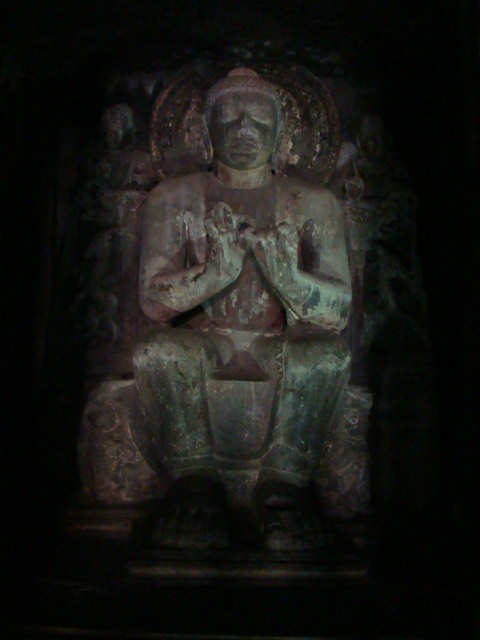
One of the Buddhas in Cave 4
One of the paintings
The patterned ceilings
 Men of the Court with their socks !!
One of the many images of Buddha and the animals depicted below
The only reclining Buddha in the Ajanta caves.
Look at the peace on his face and the ease of his body.