Hello welcome to my Blog

Mezze is widely served in the Greek and Middle eastern world. An assortment of little dishes and tasters which accompany a nice ouzo or a glass of wine. So when you read mezze moments you will have tasty snippets of life as I live it, India for four years and now Brisbane Australia, all served up with some Greek fervour and passion.

Search This Blog

Friday, 8 August 2014

The Daintree Rainforest


What is so special about this rainforest in Northern Queensland? Well in a very short answer it is said to be the oldest rainforest in the world. They say it is over 135 million years old. Australia was covered with rainforests, but as the conditions became drier, they died off. In Daintree however, the frequent rain and the topography make ideal conditions for the rainforest's survival, which extends all the way down to the sea. It became a World Heritage site in 1988 and this meets the other World Heritage site, the Great Barrier Reef, just off its coast.

In 1970 a fruit was discovered which is probably one of the rarest and most primitive of flowering plants. It is rather cruelly named the Idiot Fruit, or Ribbonwood, when in my eyes it should have been named, Bright Spark, for surviving through the eons! It was thought to be extinct but found in cattle in 1970 which ate it and died from the toxins in it. Its re-discovery helped confirm the age of the forest and make it into a World Heritage Site. 

So taking a hike or several in these surroundings is special, particularly because on one of our walks we had the chance to be guided by an Aborigine of the Kuku Yalanji tribe. We were welcomed by a traditional smoking ceremony where we all had to walk around a smoking fire,  that cleanses and keeps away the evil spirits.

We walked through the forest, stopping to listen to how Aborigines use the forest plants to protect them, to guide them and to feed them. Seeing the forest for the resource that it is for all the indigenous people but also for us. He was able to pin point the plants in the rainforest that they use to make houses, antiseptics, soap, paint and as food.
 Some of the fungi growing in amazing colours 
 The famous peak which looks like a brow and a nose of a person lying down. 
 The infamous stinging nettle which can cause severe pain for weeks if you are stung by it. 


 Rodney Bill Dockrill our guide, showing us the colours from natural pigments which they use as body paint. 
 Amazingly blue-black fungi 
More fungi almost looking like periscopes. 


The Mossman Gorge Centre was opened in 2012 and is run and managed by aboriginals living in this area. A Dreamtime Walk through the forest is a real eye opener and adventure for all its visitors. Our guide who seemed fluent in several languages was informative to listen to but also great fun. We could then enjoy a circular walk in the forest a little further on, with a different eyes.

There are many rare species in the forest.The most impressive is the Cassowary Bird. We saw the plums it eats but not the Bird.The Cassowary is the only bird that can swallow them whole and they pass, largely undigested, through its system, helping them to germinate! My favourite moment was seeing the Ulysses butterfly catching the rays of the sun, with its iridescent turquoise wings flash through the bright green canopy.
 The Cassowary Plums 
The Ulysses Butterfly, a symbol of tropical Queensland in a rare moment of settling. I could not trace why this beautiful butterfly was given the name of an ancient Greek hero of the Odyssey.

Back at the centre we devoured fried yams, a bit of a special, on the menu.


Saturday, 2 August 2014

Silky Oaks Lodge


I am sitting up above the trees, nearer their crowns then their roots. In front of me are stag horns, elk horns and crow’s nests. This animalistic image bears little resemblance to what is in front of me. Softly shaped horns, it is true, but ones that bend and flow in the breeze in vibrant shades of green.
I look below and I see the water burbling past the rocks further up, sliding smoothly before me, through an expanse of river, which shimmers green, yet unerringly translucent.


 A type of Ginger 
This is Silky Oaks Lodge, a haven in the rainforest, sitting on the edge of the Mossman river, in Northern Queensland where I had the delight to spend three days just recently.

The dining room and the reading room are beautifully positioned along the side of the river, while the tree houses are hidden in amongst the trees of the rainforest. The view from them a mixture of trunks, leaves, ferns and bark, as far as the eye can see. A hammock is offered on the balcony in case there is an urgent need to recline in front of such natural beauty.


We travelled up from Cairns and enjoyed the wonderfully warm and friendly stories of the area that Des shared with us. Tales of how Cairns, Port Douglas and Mossman grew with the gold rush and the timber and how eventually the sugar cane came to dominate the area. The slaves were brought in from the islands to help cut the cane in fields full of rats and mice, which the deadly taipan snake happily pursued. 
This snake is considered to be the most venomous snake in the world, the poison from one bite able to kill 100 men! The only way they could cut the cane safely was to burn it before it was cut to make sure that the snakes had gone before they went in with their machetes. Back breaking, hard and often dangerous work, men’s lives were lost and families torn apart.
 The sugar cane grows again rapidly in this moist and warm environment to a height of some 6-8 ft. 

Mercifully now the cane is cut by a machine and loaded onto to carts, which go to the processing plant nearby. The sugar cane was being harvested all along our journey, with vast tracks of the canes being cut and loaded onto the waiting bins.The raw sugar is exported to China. Chinese immigrants came to this area for the gold and some stayed and set up businesses. 
Port Douglas was devastated by a cyclone in 1911 and its recovery was long. It is off this coast that Steve Irwin was stung by a ray and died. It is here also that Bill and Hilary Clinton visited several times, the last time when 9/11 struck the US. The area now welcomes many more tourists and Chinese businessmen see the potential. People come here to enjoy the nice beaches but also a World Heritage site – the Daintree Forest.
The weather was a little wet – but that is not surprising- it is after all the "rain" – forest. It is probably the oldest in the world and comes right down to the sea. More about the forest in my next blog. 

Thursday, 24 July 2014

Beachcombing


The summers of my youth were spent on a beach, Famagusta beach, on the south side of the island. Famagusta is now sadly closed off to us following the Turkish invasion of Cyprus 40 whole years ago this month, when I left my home with the clothes I was wearing, never to return. 

Beachcomber was the name of a very cool club along that beach, and it felt wonderful to even contemplate going there.
beach·comb·er  (bchkmr)
n.
1. One who scavenges along beaches or in wharf areas.
2. A seaside vacationer.

Beachcombing here takes me back to those days and makes me quite nostalgic but also opens my eyes to the present and all that is around me.

I was walking in Bribie with my son at the weekend. The day was warm and welcoming. The sea calm as a sheet of glass, chilly to the first touch, but actually refreshing,  as the day wore on.

Unlike a previous visit, there were no blue jelly fishes on the beach, just their very jelly like remains which appear to be completely clear and without substance, yet formed.


The shells were few, but I kept my eyes down as we walked and talked and would often stop to examine one or other. This time I picked up some bright green pods, which seemed like splashes of colour on the white sand. I looked at them carefully, popped them in my pocket and brought them home for closer inspection. Here they are and the architect of this world must have known a thing or two about order, form and substance. It seems these are white or grey mangrove pods (Avicennia marina).Mangroves are all along the Australian coast line, but I looked at the colour of these pods, the layers of the pod and the little hairy stem that seemed to connect them altogether. I opened one up, an intense bright green succulent petal, lying flat next to another, the casing solid and strong, the texture smooth and a little darker.I wondered how their shape helped their survival. They resemble a closed fan, a purse with pockets, a broad bean of the sea. 


Plants dispersed by ocean currents fascinated Charles Darwin and he conducted a number of experiments on them concluding that most seeds sink and only 1% can float and survive sea water for up to a month and still be viable.
I look at these fruits and marvel at the complexity of their creation and sustained presence on the shores, as the waves caress each one and coax them on to the sand where the little hairy root might find cause to grow miles, perhaps, from where it started. 

Saturday, 19 July 2014

Cock-a-hoop about the Cockatoos

Our neighbour gave us a bird table for Xmas. He made it, so we feel honoured and happy to have it on our deck. Readers of this blog will know that it has attracted all sorts of birds over the months but not just birds. We have had rats, and mice which have brought snakes and possums that eat my passion fruit plants.
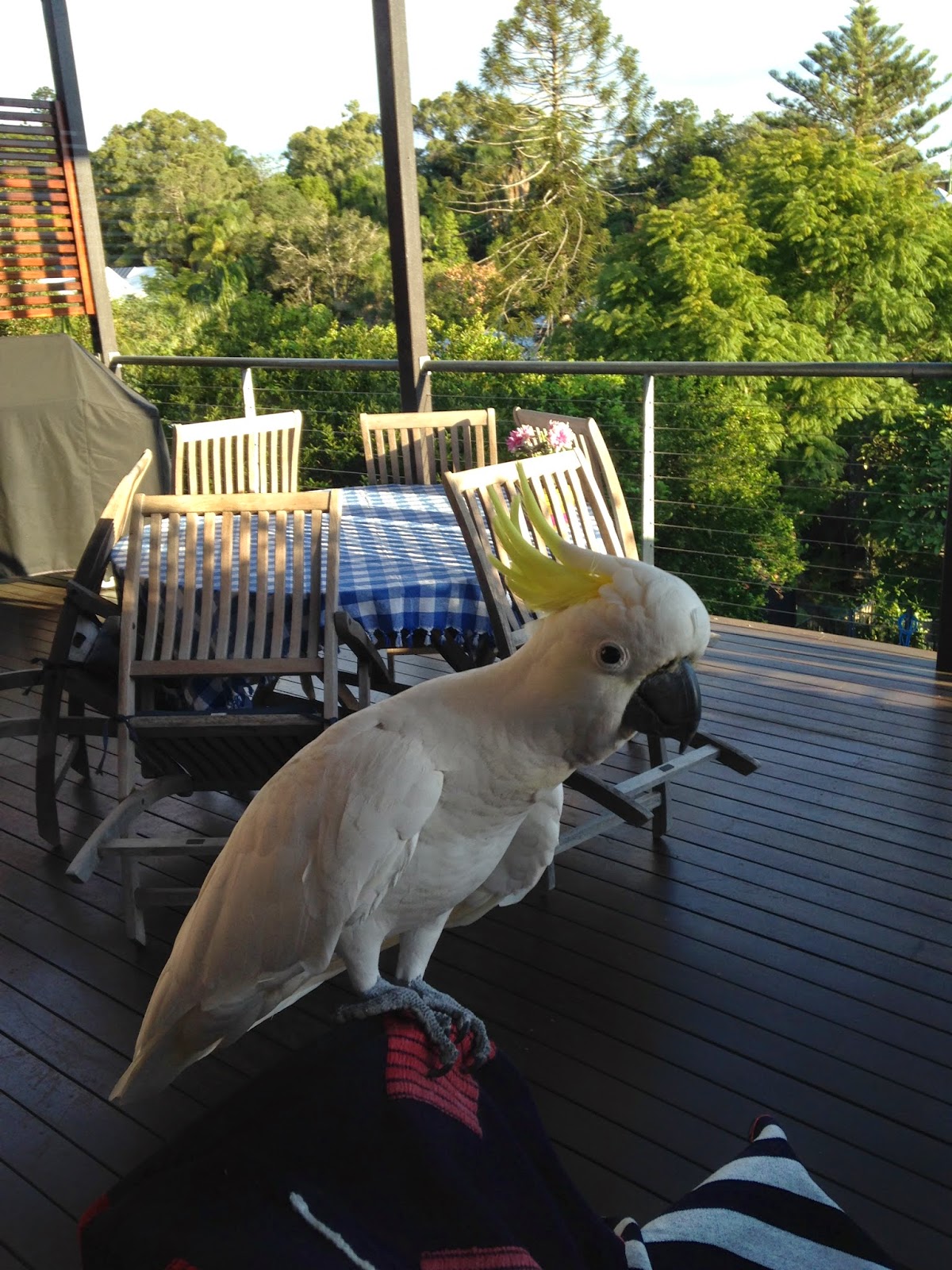
However perhaps the most frequent users of the bird table are the raucous Sulphur Crested Cockatoos. They swoop down with the most monumental raaaaak announcing they are coming to lunch. Apparently Cockatoos are not early risers ! We often get several perched on the table and we can be sitting only a few metres from them and they will  happily carry on munching the seeds, making an awful mess and then having drinks of water. I do enjoy sitting and watching them so happily share some of the pictures with you here.


More recently however I noticed that one bird that was flying in was lacking his sulphur crest and I thought perhaps this was a sign of him being in a neighbourhood squabble or like middle aged men, this is a sign that they are thinning on top. So I looked out for this one coming in, thinking perhaps it is not as resilient as some of the others. You may be interested to know that Australian birds are apparently some of the most aggressive birds in the world and have been known to destroy trees, houses and paintwork to name just a few of their achievements. Cockatoos are not only aggressive they live to a very ripe old age. That does not stop the magpies sitting in the hoop pine nearby swooping down on them and giving them a real run for their money.

When another cockatoo turned up looking as if it too had been in the wars, it lacked some of its crest but not all and its beak looked mangled I actually began to worry and on researching this and talking to a vet, a colleague of my husbands, I realised that the birds were suffering from Beak and Feather disease. Apparently they can be cured so I am heading out to the vet shop to get the right treatment for their water. So watch this space - for an update on my sick cockatoos because I am determined to get them to live to a ripe old age just like nature intended. 

Sunday, 13 July 2014

Those Greeks knew a thing or two

While wandering around in Sydney Botanical Gardens I came across this semi circle, The Henry Kendall seat, dedicated to the poet, Henry Kendall, and the winged horses carved by L Bicego in 1939. It was the highlight of my day - first because it was in my own language, so far from my origins, and secondly because it espoused thoughts and feelings which find me floating with them.


The translation of the words are : 

I walk on air 

 Contemptuous of the sun 


Just the perfect quote for this sun soaked country and what some of those early settlers had to contend with.

Monday, 7 July 2014

Sydney's Botanical gardens

We spent the better part of a whole day wandering around Sydney's Botanical Gardens and I am not sure I even took in half of it really. Its beautifully laid out with lower, middle and higher gardens and it dates backs to the first settlers and their need to put in some green spaces not because they thought that they were a priority so much as that they needed to experiment almost immediately with what they could culitvate on this vast continent. They were rudely surprised and it took a lot longer than they had anticipated to find crops that grew well here.
The gardens  are spread over some 30 hectares really at the heart of down town Sydney. You can enter from various gates, one quite low down near Circular Quay and the Governor's Mansion. Several higher up closer to St Mary's Cathedral and the State library. It is easy to navigate with helpful maps at the gates. While we were there we also took in two exhibitions which are worth seeing in Botanica, and a small exhibiting hall in Lion's Gate with the most stunning painting of plants and the other of pencil drawings of what I like to call the secret life of plants, the fronds, the stamens, the hidden orifices and intricate petals which constitute the systems by which they reproduce.

Throughout are ornate fountains, all with a history to tell of why and how they were chosen. The Levy drinking fountain,one of the few remaining drinking fountains in Sydney, the enormous fountain at the entrance and and this splendid French sculpture by Jacquemart of a huntsman and his dogs.
There are so many sections of the gardens I can only really show you some of them- the ones I particularly enjoyed. I loved the grasses in different forms, the cactus and succulents which are so extensive and successful here as well as the ferns and the bromeliads which have colourful flower stems.
 An unfolding fern frond.


A very big tree fern
A cactus of some proportions
Bromeliads with their interesting flowering spikes
My favourite succulent - the Sultan's Cap ! You can just see him wearing it.


Guided walks are offered at 10.30 am every day (11⁄2 hours), and also 1 pm Monday to Friday (1 hour) from the Garden Shop. There is always more on offer -not least one example of the Wollemi Pine, the so called Dinosaur Pine which was discovered in the Wollemi National park only in 1994. So check out the website http://www.rbgsyd.nsw.gov.au

But my favourite place of all in the botanical gardens is one for next time.