Hello welcome to my Blog

Mezze is widely served in the Greek and Middle eastern world. An assortment of little dishes and tasters which accompany a nice ouzo or a glass of wine. So when you read mezze moments you will have tasty snippets of life as I live it, India for four years and now Brisbane Australia, all served up with some Greek fervour and passion.

Search This Blog

Friday, 31 January 2014

Flesh

I have just returned from India where the issue of women's safety, equality and respect is being hotly debated, with more reported cases of gang rapes against Indian women but also western tourists, and with village chiefs suggesting punishments for women who don't tow the line. A community  leader talked about the incidence of rape being low in his area because women covered up, as opposed to other areas - clearly leaving the suggestion that womens' state of dress or undress provoke the vile, gang rapes and abuses against them.This is a place where women cannot be on the streets safely anymore, where violence is increasing against them, and where the state and the police force have done precious little so far.But actually it is not just the laws and the court system that needs changing it is the mind set of a people who have been raised to believe the boy child is the only one that matters. 

And so to Australia and to the wonderful - let me say it again - wonderful state of undress of a whole nation. I will talk only about women here to make this small, but to me, valuable comparison of how things should be. 

It is summer time here - the temperatures are pleasantly warm and occasionally hot - girls, mothers, daughters, sisters, cousins, dress in a way which shows maximum flesh - yes there is so much of it around that when I first got here it took me a while to adjust after being covered up in India. It is proudly displayed on every type of body and shape imaginable and takes on every shade under the sun from  ghostly white, to pinky white, to olive, to brown and black. It doesn't matter what colour you are nor what clothes you are ultimately not wearing. 

After years of leery stares in India, I have arrived on a continent where men go about their business as they would and do not give women a second glance no matter how much flesh she might be showing. That is not to say they don't appreciate a curvaceous body or a beautiful face or even a combination of the two - just as a woman would admire a good looking man, but there is none of that staring, the lechery which goes with prying on women and making them feel uncomfortable and ultimately not safe. I could be facetious here and say you know that old adage that some men undress you with their eyes, well in Australia I guess they cant do that as the girls do a pretty good job of it themselves ! Do not think that Australia was always as relaxed as this. Apparently in the 60s women had to wear 7.5cms of fabric at the hip of their bikinis or they could be arrested ! Think how far they have come in some 50 years. Perhaps India will show that level of change in the next 50 or so, we can only hope . But there is a serious point to this and that is I am meeting a  a society which has brought up its children to respect the sexes and to respect their freedom to express themselves. This respect has nothing to do with the colour of your skin, the cut of your clothes or your sex.And do you know, that is all there is to it. 

It is egalitarian and joyful, liberating and cool and I would happily have raised a daughter here knowing her sex would never have a negative bearing on her life, her outlook or her safety. 

Friday, 24 January 2014

Jaipur Literature Festival 2014

Its over for another year. Hard to come away and leave it all being dismantled, this year a day early, due to the heavy rain that fell in the night.Some of the venues became unusable, and had the organisers scrambling to arrange new ones on the site at the last minute.

For those who come to this for the first time, the Festival has been going since 2006. A handful of eager writers came together then and read their works at a place called Diggi Palace in the city of Jaipur. This, the 7th Festival, saw over 200,000 people go through its gates with 75,000 on Sunday the 19th of January. For India perhaps, when you think of other Festivals like the Kumb Mela these numbers may not appear that large, but for me this is the one overreaching fact that makes the Jaipur Literature Festival so special together with the basic premise on which it was founded, which is that it is free for all. 
Unlike elsewhere in this caste and class ridden society everything works on a first come first serve basis and no one can have reserved seats, or a bigger say. My friend Catherine put her finger to her lips and sushed two chatting ladies, sitting behind us, two Bollywood actresses who had come to the show. School children pour in, young people ask questions, thought provoking and complicated, the authors interact wonderfully on seemingly little rehearsal, (they are perhaps well versed in this kind of exchange) and the sessions are always on time, mesmerising and inspirational. This year I will not talk about the various sessions in great detail. My world has shifted and perhaps some of my readership so I will share with you some of the highlights.There was so much more ... I sat behind this beautiful back which I thought was worth capturing on camera and then saw her exquisite face. Just one in the crowd. 

 The makeshift venues packed to the rafters - after the rain
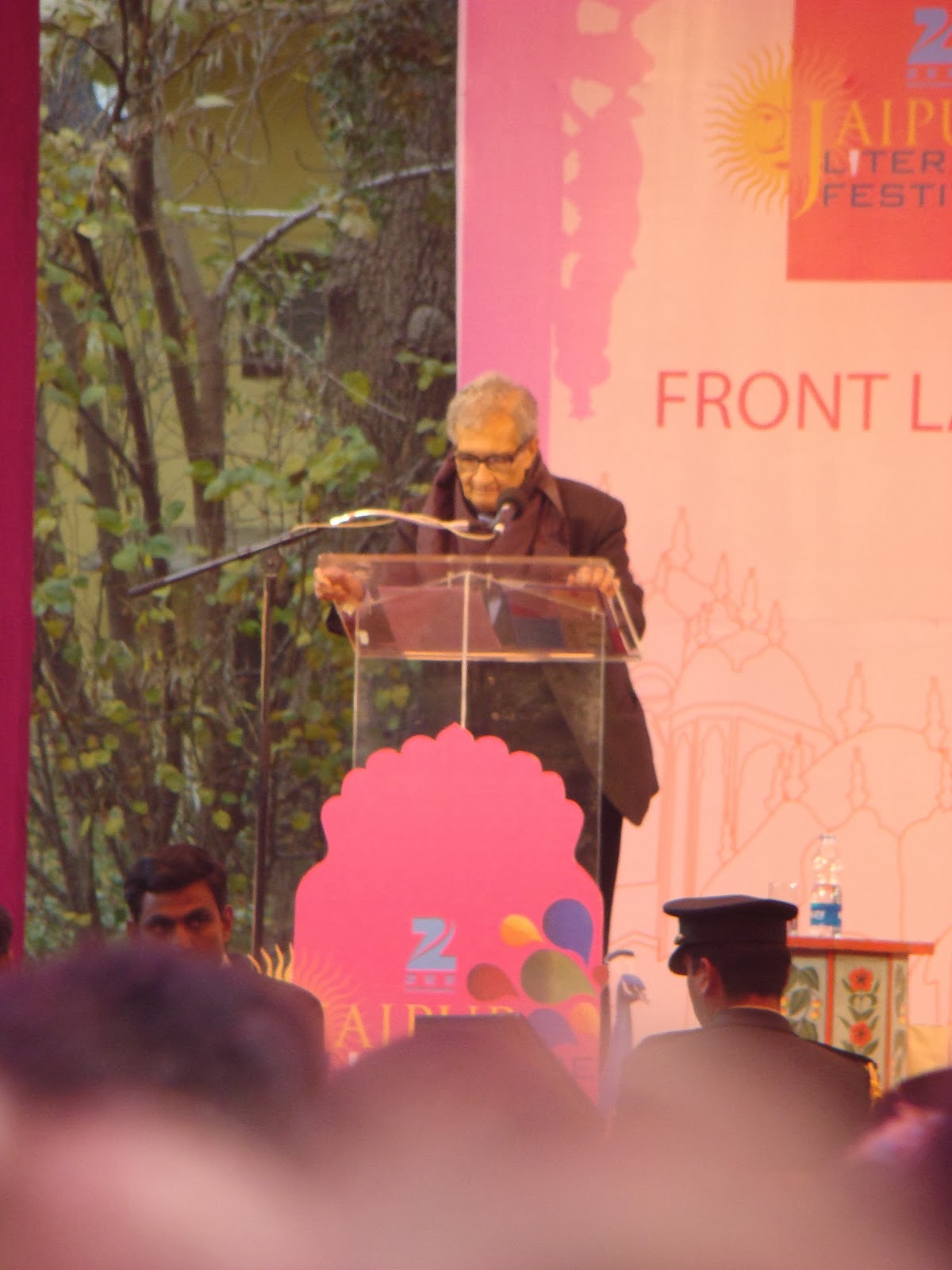
Amartya Sen, renowned professor of Economics and Philosophy came with a simple but engaging dialogue with a goddess in which he put forward his seven wishes for his country India. Things which we all wish for perhaps, but which are affirmed by someone like him. That the media is more responsive to the needs of the poor. That children have access to education and basic sanitation, including health care and clean water. That women are safe and equal in India, that the Courts are progressive and not regressive. There has been a reversal of a court case making homosexuality a criminal offence. That social media play a part in this and that we must as a consequence of these needs all read more books.
Amartya Sen on a cold morning at Diggi Palace. 
Jonathan Frantzen contemporary American Author of the "Corrections" and "Freedom" has a bit of a horror of festivals preferring solitude and dark cold places. He grew up reading lots of books and was never alone for all the characters who embraced him.
Gloria Steinem who at 79 looked great, reached out to her Indian audience and asked them to be activists for their issues, behaving as if everything does matter, no matter how big or small the action. 

Justin Cartwright and Peter Godwin on the fate of their countries, South Africa and Zimbabwe. 
Jhumpa Lahiri, telling us how she was constantly aware of her parent's sense of loss of Calcutta, growing up in America, which may have been the corner stone for her writing her stories like "The Namesake" and "Lowlands" about Bengalis and people of Indian origin. 
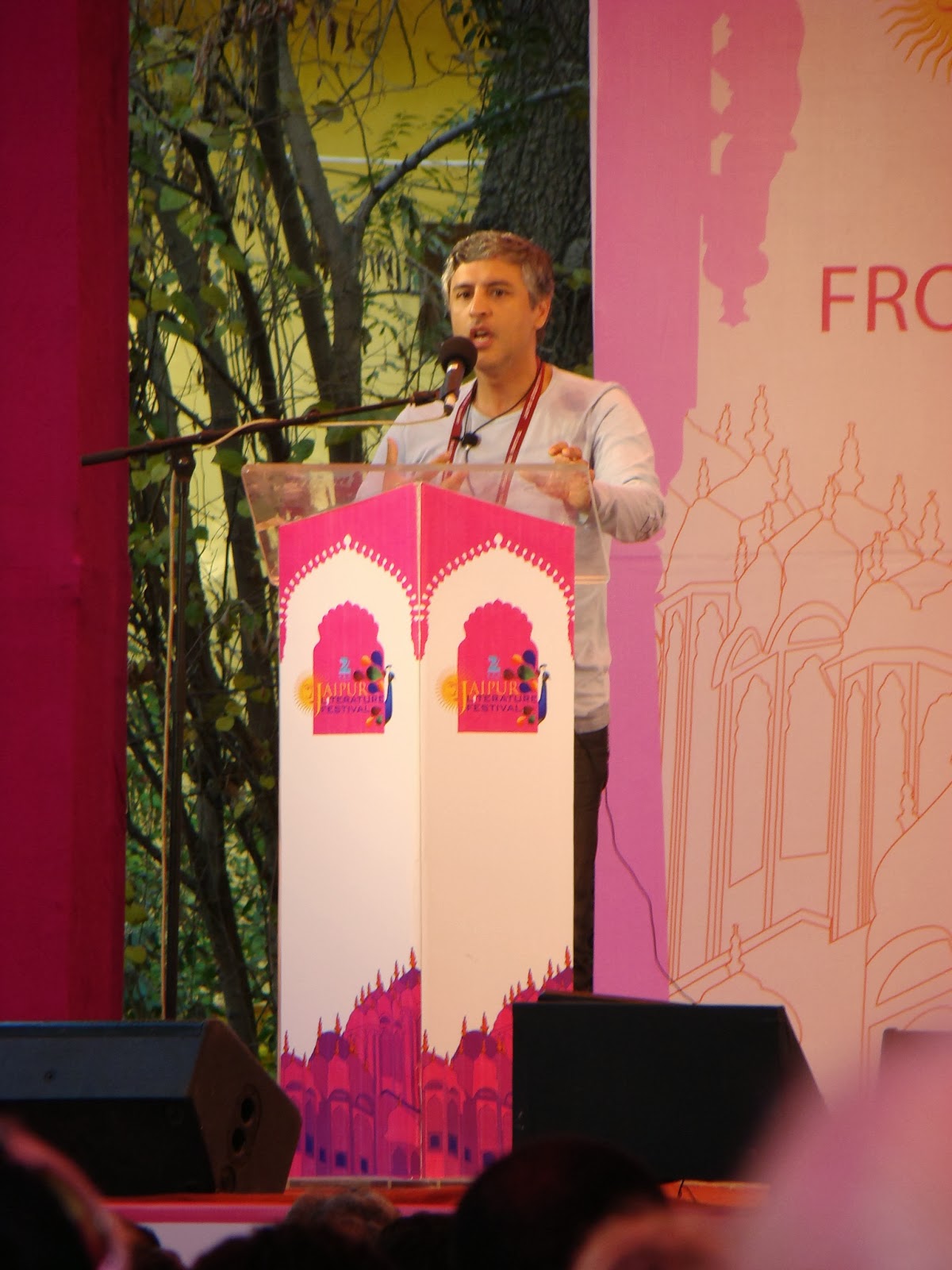
The exuberant Reza Aslan on what we actually know about Jesus. "Zealot, the life and times of Jesus of Nazareth" The equally captivating, if disturbing account by Adrian Levy of the Mumbai siege,  in his meticulously researched book "The Siege" and what the secret services get up to and even more disturbingly that they knew of the planning of the Mumbai attack and had passed the information on to the Indians. 
The astoundingly young but very accomplished Historian Maya Jasanoff talking about her book "Liberty's exiles". The loyalists to the British empire that needed to find safe havens in the British empire after the American war of Independence. 


Historians such as Anthony Beevor on war literature. He is the author of "Stalingrad", "Berlin" and the "Second World War" and David Cannadine (above)  talking about the how the British Empire was run on a shoe string budget.  Mary Beard on the Romans, Greeks and the Classics. The people's favourite Pavan Varma, diplomat now turned politician,  on whether there is an Indian way of thinking. The panel of speakers decided there wasn't but we thought there was ! 

Robyn Davidson who is based in Melbourne, talking about the Himalayas. Cheryl Strayed about her books "Wild" and "the Beautiful Things". Isabella Tree on the "Living Goddesses" of Nepal.  

A. N. Wilson whose latest biography is a "Potters Hand", a historical fiction about Josiah Wedgewood but who also wrote "Dante in Love" and "Tolstoy".I think my favourite though was Richard Holmes, a biographer of some renown whose recent book "Age of Wonder" is about what the Victorians achieved in their times, using science and skills to enhance their understanding of the world.  In a session to packed audience on the last day he recited the "Ancient Mariner" to us, telling us that Coleridge had written this seminal poem at the age of 25.His voice was captivating, the poetry rhythmical and ordered and we were all transported off on that voyage which ended so disastrously.  

 Richard Holmes reciting Coleridge.
As if all this and more was not enough to tickle our senses the nights were filed with music from sensational bands like the Sca Vengers, the Grammy award winning Malian band Tinariwen and the Rajasthani folk band, Jaipur Kawa Brass Band, together with Midival Punditz. 
My return to India was filled with the joy of seeing familiar faces, friends from Delhi, my erstwhile neighbours the Dalrymples, our old rickshaw driver who I had written about in Culturama magazine and the many characters we met over delicious lunches, standing or sitting next to us, all enjoying the offerings of what is probably the biggest literary show on earth. 

Monday, 13 January 2014

Great New Years need Great New Roads

Happy New Year ! Apologies to all of you out there for the longer than usual radio silence on my behalf.  I am back with renewed energy in the New Year sharing with you all my joys - and some undoubted upside down bits too- on this lovely new continent which is the world's smallest continent but simultaneously the world's largest island. 
A great new year deserves a great new road and there is none better that I know than the Great Ocean Road which spans the coastline from Melbourne towards Adelaide. We hired a car, jumped in and listened to the woeful cricket commentary on the Ashes while travelling on this magical road which has interesting and familiar names (to the Brits anyway) like Torquay and Anglesea.

As always I like to look into the history and this is better than most- The road is a war memorial to the fallen soldiers of the first World War, conceived and hand build (because there was no choice then) by those who were lucky enough to return and who needed employment but also wanted to honour those who had given their lives for their country. It is perhaps the worlds largest war memorial and one which no doubt inspires and invigorates as it is such a showcase of Australia's southern shore line, the ruggedness of the land and the wildness of the ocean. The beaches stretched for miles, the waves crashed on the shore, in fact it is along here that they have their famous Bells Beach which surfers love. 

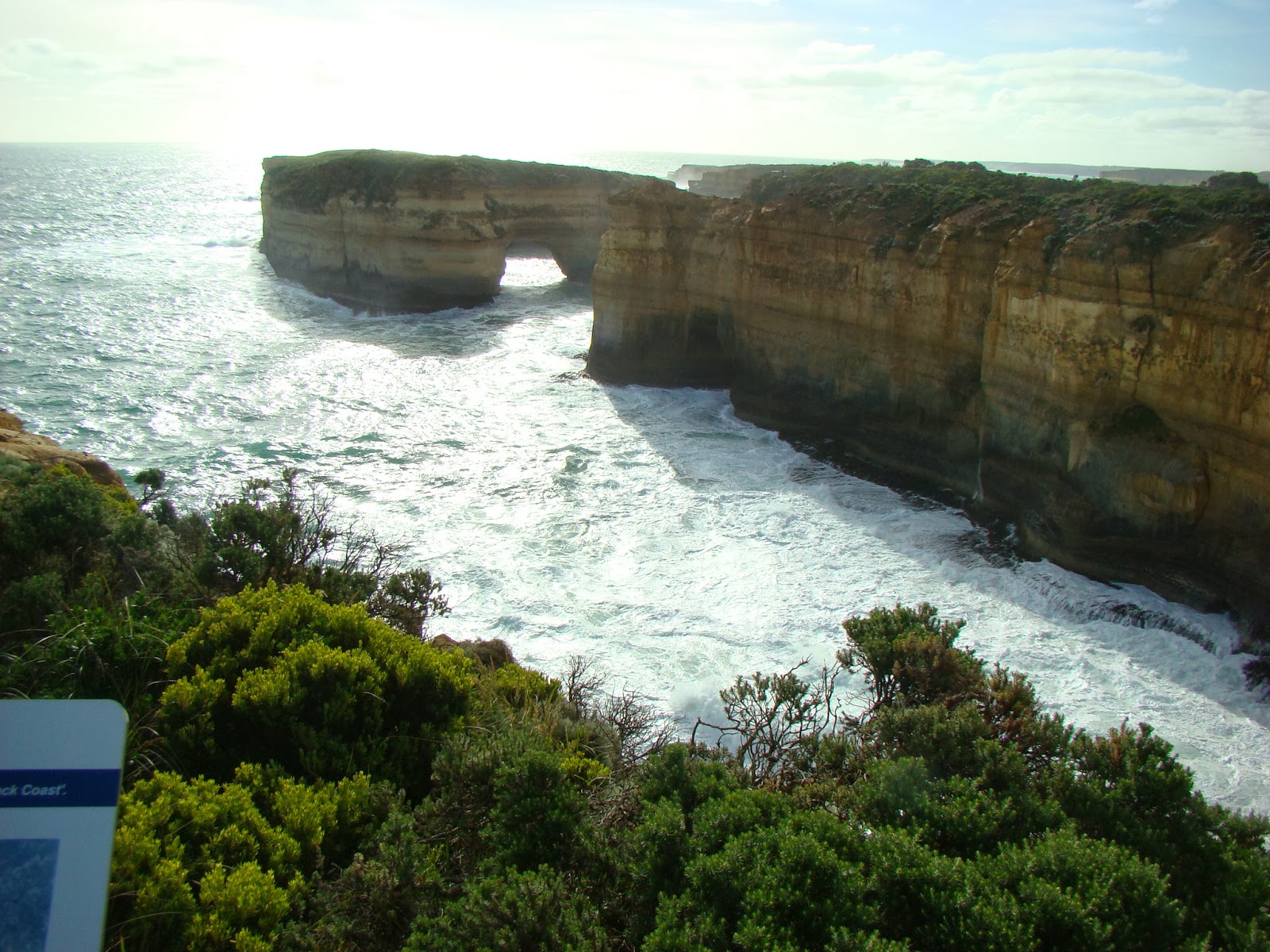
Our aim was to travel as far south as Princetown and the Twelve Apostles and en route we stopped at various memorable sites - Lorne Teddys lookout, Apollo Bay and Cape Otway lighthouse. This is also called the Shipwreck Coast and when you see the Ocean you can well understand why so many ships were dashed on the rocks. The Lighthouse dates back to 1848 and often this was the first sight of land after leaving Europe to come to Australia.


 The Twelve Apostles are the most impressive Apostles I have laid eyes on. They are limestone statuesque and glorious rock formations which stand proudly as the sea pounds their sides.


 I love the Aussie signs which dont mince their words - you may fall and DIE it says !
Close by is London Bridge as it is called and Loch Ard Gorge named after a clipper ship which ran aground in 1878. The Gorge is part of the Port Campbell National Park.


We finished the day in Port Campbell on fish and chips before travelling back into Melbourne via Camperdown, enjoying the lovely valleys and hills of the hinterland and the Otway National Park.

Tuesday, 24 December 2013

Melbourne's Merry lanes

On a recent trip to Melbourne I decided to explore its tiny lanes and arcades and it was the perfect time to do this as there was a festive spirit everywhere with the lanes beautifully decorated for Christmas and with happy patrons finding the ideal gifts or taking time off from the shopping to have a great coffee or snack. I started from Federation square and I made my way up Flinders Street to the first laneway which is called Degraves St, once William Desgrave's flour mill, now buzzing, almost bursting with little restaurants, the cafes doing a roaring trade and the shops welcoming you in to browse.

From there onto the beautifully preserved Block Arcade, where Melbournians were known to take a walk or do the block around the fashionable streets of Collins and Elizabeth. This is not far from the Royal Arcade the Oldest arcade in Australia dating back to the 1869.

 The iconic trams on Flinders street with the horse drawn carriages taking tourists.
The Block arcade with its mosaic tiled floors  
The Royal Arcade  
 Baubles and wooden dolls
 A fashionable number in one of the shops
 One of the many hip little bars and eateries
 The wonderful intricate paving in the Block Arcade
 I loved the Cut throat shaves on Degraves !
The lovely Christmas wreath and a message to say Merry Merry Xmas everyone ! 

Monday, 16 December 2013

Eucalyptus gold

After seeing Cai's wonderful exhibition, in particular his exhibit of the eucalyptus tree, it had the effect  on me he wanted - it sparked my interest - to find out more about them, to notice them and appreciate them. I grew up with eucalyptus trees, they were brought to Cyprus to fight off the swamps and the malaria and they did very well in that dry mediterranean climate. They have a distinct smell and I always associated them with the ancient ruins of Salamis and areas around Famagusta where they grew in prolific numbers. Having moved to Australia now I find them again here, and whereas in Cyprus I knew of one species here I need to acquaint myself with 700 ! 
They are thought to be 35 to 50 million year old trees. Their oils make them inflammable but their barks make them hardy so amazingly while fires spread horribly with them, they are also the reason for quick reforestation. There are so many varieties here it is actually fascinating to find out all about them. Colloquially they are called "gum trees" because of the sap they produce, but there are spotted gums and red gums, grey gums and black gum, not to mention scribbly gum. The barks can be dark and rough, smooth like silk, greenish, pink, cream, or grey. The leaves have that characteristic oval shape and are silvery green for the most part. Of course their name is from the Greek which means well covered. This refers to how the flower is concealed. Their wood makes exquisite flooring. 

They have been used by the aboriginals to make their didgeridoos, by others to extract oil for medicinal purposes. The oil acts as a natural insecticide and last but not least it is the favourite tree and food for koalas. These are ones we saw in the wild in Great Otway National park at the weekend.We spotted them high up on the trees eating and sleeping the two things they do best. One walked across the road so we stopped to look and he/ she looked back at us with a sweet welcoming face.


 A family, mum and baby above and dad snoring away below.
And the curious one in the wild looking at the wild things in front of it.
Perhaps the most interesting fact of all is that eucalyptus trees draw up gold through their roots and deposit them as tiny particles on their leaves. It is certainly a new way to check the gold deposits of the earth. These trees are golden in every which way and Cai saw exactly that when he chose to exhibit a eucalyptus tree in his magnificent exhibition.