Hello welcome to my Blog

Mezze is widely served in the Greek and Middle eastern world. An assortment of little dishes and tasters which accompany a nice ouzo or a glass of wine. So when you read mezze moments you will have tasty snippets of life as I live it, India for four years and now Brisbane Australia, all served up with some Greek fervour and passion.

Search This Blog

Wednesday, 27 February 2013

Niki


She was nearly ten years older than me and so always a bit of a mother figure, even more so when my parents died. In my youth, unlike other teenagers who probably hated having a baby sister tagging along, she would take my hand and walk with me on the beach in Famagusta where we met her friends at the King George Hotel. I made sand castles on the sand and she chatted away.
She left Cyprus to study and I missed her but when she returned once more I often accompanied her to events and friends. She taught me what is special and beautiful, important and appropriate. In later years I can laughingly say that I too could teach her of some of those lessons. She had infinite patience, positiveness and a "can do" attitude that often left us having to rethink what we had just perceived as a problem.

She was talented and versatile, turning her hand to iconography, to water colours, oils and pottery, novels, poetry and travelogues and so much more.

She was always exploring, listening and delving into subjects that had become of interest because of a journey, a book, a quote, a retold story or a work of art.

Recently she had found her niche, in terms of people and places, and with a couple of lovely friends she explored more of the Greek Islands, found joy in the conference on Durrell in London,  stayed with my boys, rediscovered old connections and and travelled to the Far East. This was accompanied by a prolific and successful production of art work and written work and there were so many plans in the pipeline....

She was my sister Niki - aged 64.

Sadly, very sadly, devastatingly for us all, she was taken away from us. She died in a car accident in Fayoum in Egypt where she was attending an Art School on the 7th of February. Another participant of the school also died.At her funeral her friends read her poems. When we gathered in a mountain village for the nine day memorial it was in St Barnabas cave, with candles burning and branches of almond blossom for decoration. The family then ate together in a typical Cypriot taverna. She would have liked that.

Life has to go on, each day a reminder of her, her books on my shelf, the painting on the wall,  the necklaces she made for me, the recipes that she taught me, the clothes she happily passed on to me when she had put on a few kilos. The pinnacle of our triangle of three sisters has gone. Anna and I are firm in our connection and our bond but it is hard to bear and hard to accept our loss. Pictures, videos and telephone messages, emails and notes suggest a presence which is no longer an exchange so much as a one way of all that was her.A way that I hope she will continue to influence and affirm just as when I was little all those years ago.


Thursday, 7 February 2013

Welcome to Australia

My excitement is palpable. I have reached down under and I am waking up to blue skies and wonderful vistas. I never imagined I would live here.  Growing up in Cyprus, Australia was a place some poorer Cypriots travelled to in search of a better life and it felt then, a little like writing them off the face of the earth, well my earth that is, as many of them were unable to make the trip back often. How things have changed. Australia, whose name comes from Australis meaning southern is no nearer, that is for sure, but somehow it is so much more in evidence, so much more of a sought after destination and at the end of the day, a couple of flights away.

So here I am on a continent I know nothing about and which I am dying to explore so the obvious place to start is with its history and origins. It was inhabited by its aboriginal  populations as long ago as 50,000 years ago and it was first discovered by the Dutch in 1606 and then came James Cook in 1707 in the Endeavour.In 1823 John Oxley was looking up the coast from Sydney to establish another penal colony and settled on the area near Brisbane river which is my new home on the east coast of Australia, about 1000 kms from Sydney.

The city has developed around the Brisbane river which snakes its way through it and divides it into north of the river and south of the river. The River and Riverside is wonderful as Cat ferries take you up and down and deposit you on the South Bank which houses most of the performing arts areas or north bank where the Central Business district is found, called CBD. It is a city which was transformed in 1986 for the Commonwealth Games and 1988 for the World Expo from a small sleepy town to a bustling metropolis which is the world's third largest municipality after Los Angeles and New York according to Queensland Travel Guide Jasons.com.au.

The city itself is just over 2 milliion so it is large enough to get lost in it but small enough to know the girl at the supermarket checkout. Regionally the population is about 4.5 million and it takes in some of the better known tourist areas of the whole of Australia such as the Gold Coast and the Sunshine Coast which includes the Great Barrier Reef all within Queensland State, also known as the Sunshine state. So to all my readers a sun-filled invitation to explore with me all this vast continent has to offer. 
The Brisbane River 


The beautiful old Customs house with the walk way and the CBD at night 


To pin point where I am on this fun map I am on the eighth floor of an apartment block on Spring Hill. 
So much more to come ...

Tuesday, 29 January 2013

Goodbye to India

Some of you may be aware that my time in India is drawing to a close and today I celebrate with you my last post from Delhi before flying off to Australia tomorrow which will be my new home.
I plan to blog from Australia as I discover this new continent so for all my readers thank you for reading and there will be more... I have spent four remarkable years here and still I cannot say I have even begun to fully explore this vast subcontinent and had enough of its culture and history, its wildlife and its people.

I would like to end this chapter in the same way I began it all those years ago with a walk in Lodhi Gardens. This is something I did with my husband almost as soon as we arrived and that walk gave me so many of the triggers that formed this time of discovery and delight.

I am happy to announce that all the wonderful trees are still there with more being planted, the stray dogs are warming themselves in the winter sunshine and the birds overcome the traffic noise with no difficulty whatsoever. The monuments are still the most stunning backdrops for romancing couples, stretching exercise aficionados and yoga enthusiasts.


I wandered all over and took in the warm sun, the crisp vegetation after last week's rain and the leaves falling to make way shortly for all the new growth. So I leave you with images of those triggers, the birds, the flora, the history and the people. My final picture is of the two little girls who represent all that is lively and colourful and wonderful about this country and who will make the music and write the verse that will be India's future in this world. 


Jaipur Literature Festival 2013

I started coming to the festival three years ago. I have returned this year and nothing about this event palls or bores - its vibrancy and energy, youthfulness and playfulness, discovery and drama is just as bit as pronounced as the first time I experienced it.

What is even more remarkable is that the organisers seem to be one step ahead of the game and the crowds, victims (if that is the appropriate word) of their own success. An event started seven years ago with a few hundred people now attracts thousands and thousands who come to enjoy the wonderful venue and the engaging speakers free and open to all. I have to repeat this in case readers do not know about this because it is the singular most amazing thing about Jaipur and it is not short of a miracle in this day and age, that the sponsorships are found and sustained to enable this great literary show on earth to be put on.

So hats off to you, Willie Darlymple, Sanjoy Roy and Namita Gokhale. Fabulous, fabulous stuff.

What I loved and took in ...

The warmth of the Dalai Lama spreading his message that you don't need an organised religion to lead a life of compassion and understanding.

A Muslim, a reformed hippy and a Buddhist from Sri Lanka talking to us in the session "If I met the Buddha on the road .... and the phrase is completed by the words...I would kill him.Basically the essence being that you can question everything in your life even the Buddha on the road if you met him on your path to finding yourself.  Each one came to talk about their own experience with Buddhism and its teachings.

Pico Iyer's magnificent analysis of Graham Greene and why he was such an important figure to him in his book "The Man within my head." His examination of the themes of rootlessness and identity powerfully portrayed.


The panel on India and China in their quest for the top spot from such knowledgeable people as Gucharan Das, Nandan Nilekani and Peter Hessler talking so openly about the challenges but also the surprises in China. While the state is strong in China the people seem to live their lives without being enmeshed in it. Whereas the opposite is perhaps true in India where the State is weak but the society is strong.

The absolute joy of laughing, weeping, writing with the hilarious Gary Shteynghart and Deborah Maggoch a writer of many novels and screenplays but perhaps more recently known for the adaptation of her novel These Foolish Things into the Best Exotic Marigold Hotel.

A wonderful session on the Jewish Novel with Howard Jacobson, Linda Grant and Gary Shteynghart Their sheer wit and repartee had the whole audience laughing their heads off.

The repeated issues about Kipling. Famous for his poems, and his writings, born in Bombay but clearly it seems, an imperialist in his later years, and how far this affects his legacy from a distinguished panel of Andrew Lycett, Charles Allen and David Gilmour.

I had lunch next to Richard Sorabji an engaging and knowledgeable Fellow of Wolfson College Oxford and he told me about his aunt Cornelia the first woman judge in India and her relationship with the Mahatma. I then had the pleasure of listening to him talk about Gandhi and his interpretation of his character, his philosophy and his behaviour.

The wonderfully engaging session chaired ably by Aminatta Forna on Global Souls where Pico Iyer told us that Home is not a piece of soil but a piece of soul.Abraham Verghese quoted a Napoleonic saying that "Geography is destiny" and cited his own example of his parents taking him to Ethiopia where he was raised.

His own session on "Cutting for Stone" was one of quiet contemplation, how affected he was by the loss of his only homeland Ethiopia, and his life in the US where he works as a physician. 
  
Willie regaled us with tales of British blunders in the first Afghan war of 1839- 1842. The British travelled with their port and cigars and even the grand piano but were squarely and fairly defeated only months later into their occupation of Kandahar on the basis of their rather shameful behaviour there. Only one man out of 18,000 who went into Afghanistan surviving. Lessons for now ?

The fascinating accounts from correspondents who cover war, with Lucy Morgan Edwards pointing out that the fact that she was a woman gave her access to 50 % more of the population. She actually lived with an Afghan family for a some time. 

I loved Howard Jacobson telling us how he grew up in Manchester a much loved and cossetted child, and the abject rejection he felt when his more beautiful brother came along. His efforts to turn himself into an English gentleman came to naught in Cambridge, but how he eventually found his voice threw addressing the issues which always put him on the edge, his Jewishness, being stuck in Wolverhampton Poly teaching and writing successfully about them with his first novel "Coming from Behind". Winning the Booker with "The Finkler Question" and his latest which is called "Zoo Time" a book about the end of literature and a failed writer. 

Though not something that would be my first choice I attended a session called the Big Bang and all I can say I have never heard science explained so well and so entertainingly as by Simon Singh. Hats off to him. 

And finally but perhaps purposefully listening to the delightful and knowledgeable Madeline Miller talking to us about her Book " The Song of Achilles" which won the Orange Prize for literature. She talked enthousiastically about the epic Iliad and her desire to portray the lesser but gentler character Patroclos as the protagonist in her story. How this took a full ten years to write with her realising half way that she needed to throw out what she had written and start again, so as to find her own lyrical voice in the story which I think she did magnificently, judging by her readings. But what courage to be able to start again..

In each author, journalist, activist or correspondent voices of commitment and courage and inevitably with that comedy and creativity that leaves me wanting for more. Sadly it is over for another year but for me a fitting end to my time in India which has given me above all the luxury of literature without bounds. 


Wednesday, 23 January 2013

Hampi the ancient city

The area is vast and you need time to take in and appreciate the sights of this ancient city. I will concentrate on some of the more remarkable ones which I felt made Hampi such a rewarding experience.

The city was built in the 15th century and was built on a river in this granite rich landscape. The building techniques were impressive then as they are now and the remains a testimony to their civilisation and their expertise.The time and architecture is known as the Vijayanagara epoch.


Evidence of the paintings which adorned the temples 
The magnificent gateway 
One of the main temples there, the Vittala temple Complex displays the remains of the main temple where every pillar is able to emit a specific musical sound when hit dependent on its thickness and length. To imagine the music that came out of this stone building is phenomenal in itself.

In front of this temple is the stone Chariot which is often referred to as a monolithic structure but actually is cleverly built with granite pieces joined artfully and discreetly to form this shrine.
The amazing Stone Chariot
 The tank 

They had extensive and well organised markets as well as aqueducts and waterways that allowed the city to be supplied with water. The Queens had their very own Baths where system of cooling the water enabled them to enjoy relaxing sessions.
The city sprawls out over many kilometres and each area is dotted with more temples, carvings more impressive then the last and vistas over the surrounding areas to die for. They certainly knew how to chose their locations and we watched the sun dip over the city in its full and powerful glory.

 The elephant stables
 This trough is reported to have been carved out of a single piece of granite
The Lotus Mahal used for pleasurable pursuits- the imagination runs riot here 
The view at sunset 
 The beautiful step tank
Us and in the background the Virupaksha temple which is a living and practising temple to this day.


Thursday, 17 January 2013

Hampi- the landscape

I wonder if there have been travellers who have travelled the length and breadth of this country and said YUP seen that, done it all - we have been here four year and there is still so much to see and what is even more amazing is how spectacular it all is !
Our recent adventure was to Hampi in Karnataka, a massive complex of some 27 square kilometres of an ancient sprawling city. The scene unfolds on this ancient city and there is no way you can dismiss it as another set of interesting ruins -

Let me start by describing the country side in which this site it found. Well I for one have never seen anything like it. It is quite dry and hot even in the cooler times and there are flat plains with occasional hillocks on which rest the most amazing boulders. They rest precariously one on top of another or propping each other up in the most bizarre fashion. To me it looked as if a giant had taken a walk through the country side and picked up these boulders and then placed them higgledy piggledy here and there and on top of one another. I am not entirely sure what the geological answer to this phenomenon is other than perhaps that they may have resulted from volcanic eruptions but even that I am not sure about. It is said that they are among the oldest rock formations in the world and these huge lumps of granite, because that is what they are, were thrown up by movements in the earths crusts and then eroded by the sun, wind and rain over millions of years to the forms they are today. So that sets the scene for you which in itself is a staggering landscape to behold.  More on the ancient city soon. 

Thursday, 10 January 2013

Nagarhole

There is a little park in the south of the country which to all intents and purposes has one of the highest density of animals in the whole of India.It is called Nagarhole  also known as Rajiv Gandhi National Park, located in Kodagu district and Mysore district in Karnataka state in South India. There is an abundance of wildlife here, elephants, hyenas, leopards, birds...

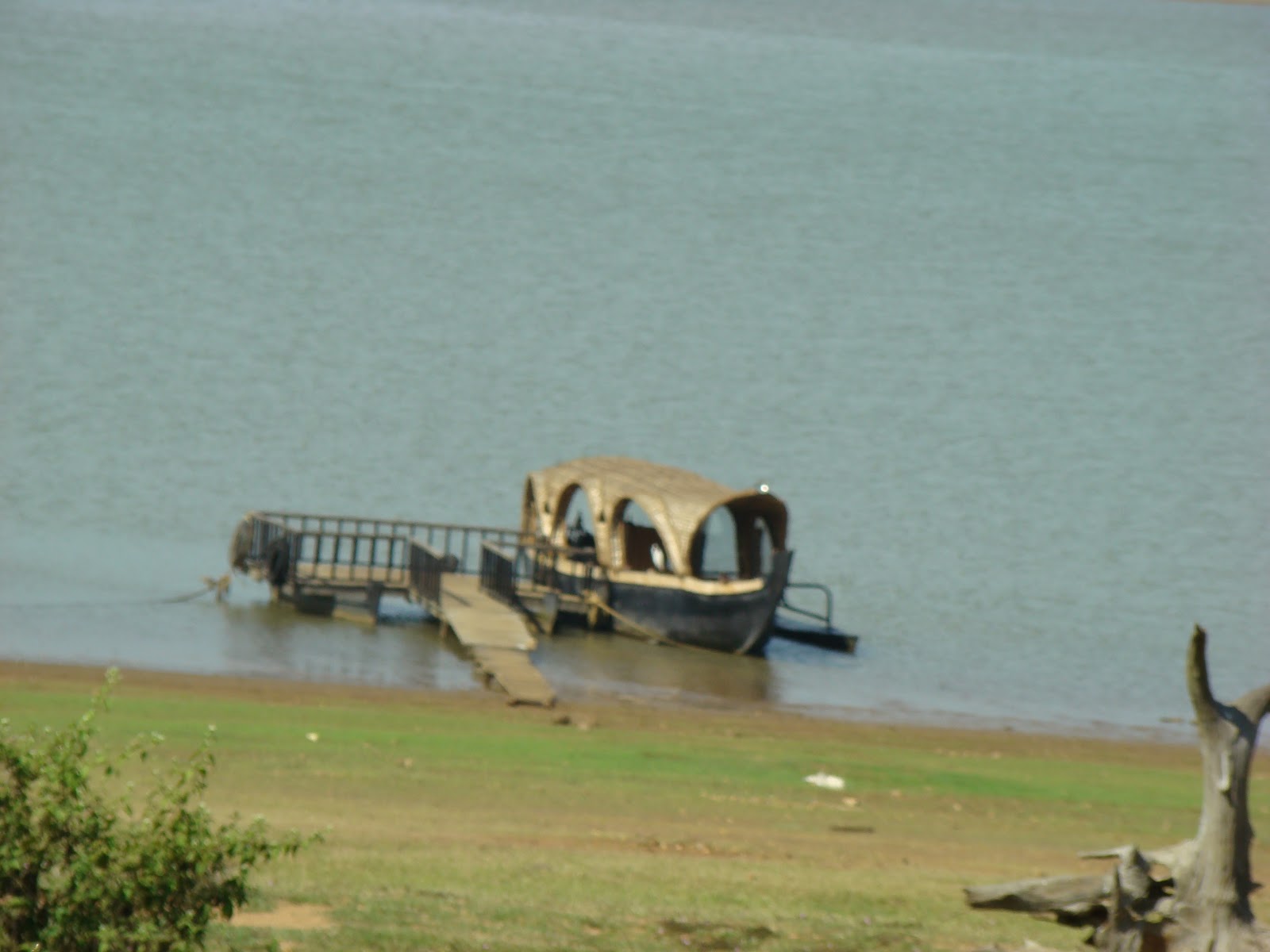
We arrived at Orange County Kabini which is located on the edge of a big dam with panoramic views of the dam and the forests opposite and we loved the comfort, care and attention lavished on us by all the staff there. It is a particularly well thought out resort with a vanishing pool by the dam and a family pool in a different location. It even boasts a library and reading room with big open vistas where you can sit, enjoying a cup of good coffee leafing through the coffee table books of the resort. My idea of heaven. 

What however was exceptional was the organisation of the safaris and the way they were run. The park is divided into A and B zones which makes it quite easy. Limited no of vehicles are allowed in every day and they can be 8-10 seaters or the larger 25 seaters. You are always accompanied by a knowledgeable naturalist. Our purpose in visiting this park was to see dhole - wild dog. Very rare but apparently reasonably well sighted in this park. 

Sadly it was another vehicle that spotted them not ours but we had wonderful outings and saw plentiful wildlife and on one morning counted 11 crested serpent eagles which apparently was a bit of a first. Some of the images to share.