Hello welcome to my Blog

Mezze is widely served in the Greek and Middle eastern world. An assortment of little dishes and tasters which accompany a nice ouzo or a glass of wine. So when you read mezze moments you will have tasty snippets of life as I live it, India for four years and now Brisbane Australia, all served up with some Greek fervour and passion.

Search This Blog

Thursday, 24 April 2014

All creatures great and small

Home to strange creatures and many birds the rain forest canopy, its floor and streams are full of surprises, some visible to the naked eye, others not. We walked through the graded paths, stroked by the ferns which reached out, almost tempted to pluck the pendulous berries of red of the strangely named "walking stick palm" that was the only shot of deep red in a sea of green, avoiding the stinging nettle tree which is notorious for not being kind. We looked up and we looked down, we paddled in streams and on one occasion fell in looking for the crayfish, we saw the amazing front door of a trap door spider made with mucous and mud and with a perfect hinge in silk - an undisputed "keep out" to the world at large. We sat tired to soak in a view and then soak in the sun after the coolness of the forest.

Mushrooms having a field day on a mossy branch

The door to a trap door spider's nest

The crimson Rosellas on our balcony

 The Eastern yellow Robin

 The Eastern Whip bird
 A delicate flower that C and I spotted independently of each other
 A king parrot in the canopy
On open grass we saw many pademelons, a smaller form of wallaby, foraging in the grass. Bandicoots and other smaller rodents scurried around.

The glow worms lit up a whole bank and their lights were reflected in the stream below. They were mesmerising enough that I forgot to take a picture so here is David Attenborough with his little clip.


The birds are what we really loved to listen to and watch and we very much enjoyed spotting them around the retreat and in the  forest. Not always easy to see, their calls and songs, their only give aways.
The crimson rosellas were astoundingly bright and colourful and tame enough to come to our balcony. The Australian King Parrots with their royal red heads and their body of green occasionally high in the branches above our heads. The pied currawong with its unmistakable song - red browed finches with their red mask like spiderman across their eyes. The wonderfully named Wonga Pigeon with its patterned belly. A rare sighting of a noisy Pitta and of an Albert's Lyrebird the latter known to do a dance close to a Spanish Flamenco to attract its mate. The jovial and flashy Eastern Yellow Robin, the Log Runners scurrying around in the undergrowth and the unmistakable whip bird with its whip whip call. Too many perhaps to mention them all but the Regent bower bird is one which is so memorable with its fiery yellow on its body and the impressive bowers that they form to attract their women folk. 

Picture from Graeme Chapman 

A bower

Lying in the ground in areas which are a little secluded and protected they will collect "treasures" for their women, Bic pens, bottle tops, straws and blue feathers. What a welcome to a wife. 


Tuesday, 22 April 2014

Lamington National Park

We drove up to Lamington National Park from Brisbane and as you leave the valley and start climbing the mountain, the road, often single lane and narrow, prepares you for living in the forest for a few days. The trees, the ferns and the bushes grow up and over and envelop you in almost a tunnel of green and if they do not meet at the top, they reach out from the sides to welcome you in.

Once upon a time we know that Australia was part of the land mass of Gondwana. Australia broke away about 55 million years ago and has been moving north ever since. There were seas and volcanoes on its land mass and the volcanoes left mountains rich in nutrients which in turn gave rise to some of the areas on which the rain forests grew. Lamington Rain Forest is one such. In 1915 Lamington was declared a National Park. A few dedicated men had fought for this but it took many years before it was passed. In 1994 Lamington National Park was listed as a part of the World Heritage Central Eastern Rainforests. Today it stretches over a vast expanse of some 20,000 hectares, is surprisingly close to the ocean, and is literally  a skip and a hop away from our doorstep. 

We spent the Easter weekend at Oreilly's Rainforest Retreat and had a wonderful time exploring the tracks and the forest, the waterfalls, creeks and rock pools. Saying that we were awe struck by what we saw does not even begin to convey the majesty of the trees, the richness of the canopy, their height and the variety of species found there. There are maps and discovery centres to help you find the walks that suit you or your family, always well marked and for the most part very walkable with the most spectacular views of the border with New South Wales or the Gold Coast and the valleys below. 
 The view from our room
 Along one path, passing through a tree hollow
 One of the foot bridges
 Disappearing into its heart
 The forest with the morning light
One of the many beautiful symbiotic plants 

All those years ago a man called Francis Edward Roberts had been asked to survey the border between New South Wales and Queensland and he worked on this between the years of 1863 and 1866.He was helped in this by Aboriginals who had lived these areas and knew them well. Most of the place names are Aboriginal. In some areas the vegetation was so thick that they could barely see daylight. We walked along this Border Track, a distance of some 22kms but extended somewhat as we dipped in and out of the beautiful Coomera falls and meanderings across the river bed which saw us crossing water courses maybe eight or so times along our path.We came across breathtaking look outs and old forests of Atlantic Beeches which look strangely prehistoric and mixed with one of the world's oldest conifers the hoop pine, araucaria cunninghamii, and strangler vines, hosting everything from crows nests to orchids, to stag horn ferns, they engaged our fantasy as well as our thirst to find out more about what birds might nest there and what strange creatures call them home. 


 Some of the waterfalls we came across


 The breathtaking vistas from the look outs
The tree fern and behind it one of the Atlantic Beech trees. 


Wednesday, 16 April 2014

Ferran Adria - el Bulli


Ferran Adria breezed through Brisbane. The master chef and father of molecular gastronomy was talking at the Gallery of Modern Art. I could not miss this. 

Adria started in el Bulli in 1983.Within a short period of time his cooking became legendary. There were waiting lists that went into years not months.He came to talk to us about his experiences and what he is up to. In the last 25 years, he said, nothing ever stayed the same from year to year. There were constant innovations, explorations and menus that left diners with their mouths literally gaping.He closed his restaurant el Bulli in Spain in 2011, the last serving was not a sad day but rather the start of a bigger more innovative programme.
He decided to close it because it was madness to change everything every year. He compared this to an artist innovating art radically every year. He wanted to get away from the Michelin stars but have the freedom to create. He has now created a family Foundation, perhaps because he doesn’t have children, where all income generated goes to the Foundation. They auctioned off the wine cellar at el Bulli and made 2 million Euros. They put in further funds and the Foundation is moving forward. He has been on a tour of major Universities and Business schools asking for their input to his plans. The Foundation will be on the same premises as the restaurant and it will be where chefs under elBulli DNA will continue to innovate and create. Their creations will be put online and will be available to all. At the same time he is working on el Bulli 1846 (after the number of dishes he created) which will not be a museum, nor a lab, but something in between the two. He plans to launch Bullipaedia which will embrace projects about education in the food industry and cooking which, as he put it, will not just be for the elite but free for all. He has even questioned what is the definition of cooking a question that will doubtless engage anthropologists in the years to come.

He left Brisbane with a promise of more to follow and while I would struggle to emulate even his simplest recipes in the kitchen I am fascinated by his mind, his passion for food and its preparation and cannot wait to see where he wants to take it.


Thursday, 10 April 2014

In praise of Baju from Bihar

For any of you who knew me in my Indian life I lived on a so called "Farmhouse" in South Delhi surrounded by large gardens and some pleasant neighbours. My gardener was called Baju and he was employed by my landlords but sadly at such a small salary we had to surreptitiously supplement it every month. Baju came to work day in and day out -whether the outside temperature was 5C or 45C as it was sometimes. He swept an expansive garden free of leaves and branches and also trimmed hedges and kept everything in order. He did this day in, day out. 
He was an unskilled and uneducated young man from Bihar, India's poorest state and he left behind a wife and twins when we first arrived. Within a year, one of the twins had died and another baby was on the way. He saw his wife and kids maybe once a year and sent them every penny he made. He came in for a cup of chai mid morning and was always surprised because I had the best chocolate biscuits on offer for dunking.He worked long hours, for not very much.So this is a tribute to his hard work, his lovely smile and his ability to complete his daily tasks. It takes strength to do so but also there was something more that I had not counted on. 
Why on earth you might ask have I suddenly brought this up - simply because in Australia I am Baju and daily I head out to the not so expansive garden and sweep the blossoms that have fallen from the frangipani and the tibouchina. It is to my intense surprise therapeutic and calming
 Some of the garden he looked after 
 Baju and Tara on Holi having fun with colours 
and I love the fleeting sense of achievement as I collect all the dead leaves and put them into the compost bin and for literally moments the garden is spartan and swept.  The wind blows and the whole cycle starts over again. I head out in the knowledge that this man from Bihar has taught me a valuable lesson in my life and this post is dedicated to him and his family on this day when India heads to the polls.

Thursday, 27 March 2014

Kanaks and their art

I was lucky enough to be in New Caledonia to catch an exhibition which had just opened there "Kanak L'Art est une Parole". The idea started up as a collaboration between Paris and New Caledonia and the result is that more than 160 pieces of original Kanak Art are displayed in the Centre Culturel Tjibaou. The Cultural Centre was modelled on the Kanak Great Houses and is quite a landmark on a hill.
If you are anywhere near, make the trip. It is well worth it and will be on until the 15th of June.

The Kanaks are the indigenous Melanesians inhabiting these islands. Their exact origins are unknown but they constitute about 40 % of the population and they have endured many hardships, disease and dissemination. They fought as French soldiers but also for their independence.Two leaders who signed the Matignon Accord in 1988 were assassinated - one of them was Jean Marie Tjibaou in whose honour the Cultural Centre was built and which currently houses the exhibition. Another accord the Noumea Accord has given them a degree of autonomy with the promise of a referendum for independence from France in the next four years.
The Centre Culurel of Tjibaou 
Kanaks have many customs and beliefs involving the sea, their ancestors and gift sharing and exchange. A lot of them are now Christians so it is important to see their art, and their customs given prominence and care.Efforts are also being made to preserve their many many languages, 28 in all, which are apparently mutually incomprehensible and often based on oral tradition. 

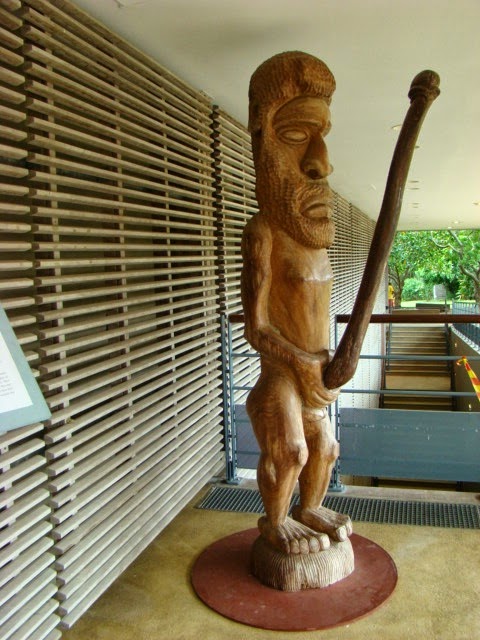
For me the most impressive pieces were the ceremonial jade axes which often resembled the sun. They were honed and sharpened in the sand. Akin to them are the war clubs - often phallic and bird like. 

The Great Huts were their chieftains houses which were built with huge care, involving many months of painstaking work. 
The pillars or posts are often carved intricately with patterns and masks.
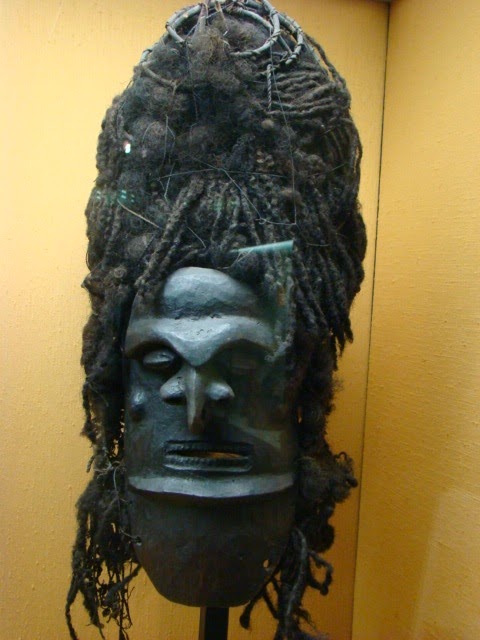
The most incredible however are the masks which the men wore after a mourning period for a Chief was over. Elaborately carved with fantastic powerful faces they also have a mass of real hair in bouffant hairdos which take some making. The masks are worn by men who can only see out through the slit of the mouth.

While I was busy looking at them they were also busy looking at me.To most Noumeans I was also incredible - they had never met a person from Cyprus before and were about to call the local paper to announce my arrival ! 

Friday, 21 March 2014

New Caledonia

The airplane door shut tight and all of a sudden, tout d'un coup, we were in France. It was quite bizarre, the announcements were in French, Antoine my neighbour on the plane, was keen to talk and tell me about his own life story and with the help of some good french wine did not stop to draw breathe once.  I had to instantly think of my verb book and get my verbs in order. We were on our way to New Caledonia in the South Pacific. Unbeknown to me the island had first been discovered by James Cook in 1774 and named New Caledonia, as the north part of the island reminded him of Scotland!Nothing very Scottish in these southern coastlines I think. 

 This raft reminded me so much of my youth in Famagusta so I had to take a picture of it.
We landed in Noumea, the capital of this long and lush island, which is surrounded by islets, mostly coral atolls with the most magical reefs around them. The roads were perfect, the driving was distinctly on the right and the signs all in French. We were on the southern most tip of the island. The natural harbours were what originally drew the attention of the French when they took over the island in 1853 under Napoleon III. They were initially used as a penal colony and once the convicts had served their terms they were given a parcel of land and allowed to settled. There was a huge shortage of women so the Empress Eugenie gave free trousseaus to girls who were willing to come over and settle. The island is also rich in nickel so mining became a source of income for the island and continues to be so. 

The local Kanak population has been though some rough times and there are still issues of representation, self determination and employment for them.  Nowadays they seem widely employed and ALL speak French. In fact the one thing that really surprised me is that I did not once here the local langauge spoken or one of them. The island is divided into eight different liguistic areas with 28 different languages. Perhaps French is the unifier.I travelled the south island on the bus. I sat there looking at the mamas around me in their traditional dresses and thinking of those French missionaries who all those years ago were determined to get rid of the nudity by introducing the missionary dress. A shapeless rather broad unflattering but comfortable floating cotton frock which all the women wear to this day- mutlicoloured and flouncy. I dont know if the style determined the shape or the shape the style - a lot of young girls are thin and dressed in western dress. They reach a critical age, not sure where this might actuallly lie in real years but they start growing ourtwards and I would say that the majority of women I saw were wide girthed and incredibly weighty. The place I stayed at was full of the art of Paul Gauguin though his women were mainly Tahitian. However the contrast was an interesting one. 

The men - the young ones are mostly dressed in western shorts and t shirts, many with dreadlocks or long hair. There were enough of them in the central square to suggest that perhaps unemployment of these youths was an issue but I also loved the fact that the centre of the town was the Place de Cocotiers a leafy green park full of coconut trees where families, women and young things could hang out for the day or while waiting for the bus. Travelling on the bus women greeted me with wide smiles and friendliness. In the backround, the radio blared french ballads. 
Everything about the place breathes and speaks of metropolitan France. In fact people identify themselves by saying whether their parents came from metropolitan France or not. A lot of the young people have grown up on the island and seemingly live a happy laid back existence. The standard of living is high, prices are French, and the infrastructure is well maintained. It was bizarre to say the least to wake up to a breakfast of croissants and the weather in metropolitan France splashed all over the television screens- il ya du brouillard aujourd 'hui ! It will be foggy today !

More on the Kanak art and life soon. 

Thursday, 13 March 2014

My first miners -Their story.


I met John and Leanne at their stall on Brisbane Riverfront when I was looking for something completely different. They were lovely and we got chatting. They are the first "miners" I met and so I made a point of contacting them and finding out about their story. Leanne very kindly wrote back. I am sharing this with you all as I think it is a lovely story of how one finds passion in life and goes after it. They certainly have, and while it is not easy they have done it and still enjoy it. 

This is their story: 
"Johns father was involved in opal and mining in the 1960’s and 70’s, so John travelled around the opal fields with his father a lot as a kid, he has always had an interest. Always said “one day I want to go mining” so I guess it rubbed off on me too.
We were both hairdressers and had salons in Sydney and the Gold Coast, in our time off we travelled  a lot around the opal fields and generally outback areas. We both love the remoteness and wide open expanses of inland Australia. So we played a little as amateur noodlers (fossicking through other opal miners leftovers) all the time becoming tired of the hustle and bustle of life on the Gold Coast, I think the term these days is burnt out, but we easily  became hooked with our 1st hint of colour.
One of our  good clients was very involved in the opal industry, she had retail shops, and a couple of opal mines. Kathy offered us a partnership in a mining operation, so off we went in 1999. We sold our business, put our furniture in storage, tenanted our house, towed a 20ft caravan out to a place we had never before even visited ...... to live at Opalton, an opal field 135 km from Winton in western Queensland.
We learnt how to operate a 28 ton excavator, a front end loader and  I knew how to drive a truck (I grew up on an apple orchard in Victoria,  always was a bit of a tom boy). We didn't really know much about finding opal though. We had a couple of lean years mining then started to find some opal.  And yes, it is very exciting finding opal, we shout and yahoo, carry on a fair bit. I don't think that ever wears off.
We still feel the same excitement and the emotional and physical roller coaster of opal mining that I wrote about on our website.
Our early experiences selling the rough opal to dealers was very upsetting and disappointing. The dealers knew we needed to sell ( the saying goes “you cant eat opal”) and were inexperienced so offered a low price.
So we learnt the skills  to cut and polish our own opal. Our original styles were very modern and different to what was traditionally being done with opal. We shaped and polished the boulder opal then drilled a hole tied some knots with leather to make  casual pendants. Our first display and sales were in Winton during the Outback festival, there were 3000 people in town. We had made 80 pieces as a trial and sold the lot. All the other miners were in town for the festival, all told us we were wasting our time with this style of opal, which is now a very popular style with boulder opal.
As the average temperature is 45 degrees through summer  we decided that  we could avoid the worst of the heat and sell our pieces at markets on the coast , this could be our summer job. Both of us are creative so as things went along we started to make all sorts of opal jewellery and  business improved.  Now , we spend  the cooler months out west mining ( we also buy rough from our mates to give us variation), and the summer months here on the coast (our workshop is at home) cutting, polishing and designing opal jewellery.  We display at the weekend markets and supply various jewellers all over with our jewellery.
Opal mining isnt like other mining in Queensland with huge companies mining  in a big way, it is all small mining operations, like 2 mates, or a couple of brothers, father and sons and a few husband and wife teams.
Well that finished up being quite a lot , I hope I havnt drowned you with words.
I think you might have gathered that we love what we do, it is our life.
I  enjoyed looking at your blog, I like the botanical gardens part in Brisbane, those figs are great.
cheers
Leanne"
You can find John and Leanne on :
http://www.boulderopalsaustralia.com

More about the creation of opals in another blog.