Hello welcome to my Blog

Mezze is widely served in the Greek and Middle eastern world. An assortment of little dishes and tasters which accompany a nice ouzo or a glass of wine. So when you read mezze moments you will have tasty snippets of life as I live it, India for four years and now Brisbane Australia, all served up with some Greek fervour and passion.

Search This Blog

Thursday, 24 July 2014

Beachcombing


The summers of my youth were spent on a beach, Famagusta beach, on the south side of the island. Famagusta is now sadly closed off to us following the Turkish invasion of Cyprus 40 whole years ago this month, when I left my home with the clothes I was wearing, never to return. 

Beachcomber was the name of a very cool club along that beach, and it felt wonderful to even contemplate going there.
beach·comb·er  (bchkmr)
n.
1. One who scavenges along beaches or in wharf areas.
2. A seaside vacationer.

Beachcombing here takes me back to those days and makes me quite nostalgic but also opens my eyes to the present and all that is around me.

I was walking in Bribie with my son at the weekend. The day was warm and welcoming. The sea calm as a sheet of glass, chilly to the first touch, but actually refreshing,  as the day wore on.

Unlike a previous visit, there were no blue jelly fishes on the beach, just their very jelly like remains which appear to be completely clear and without substance, yet formed.


The shells were few, but I kept my eyes down as we walked and talked and would often stop to examine one or other. This time I picked up some bright green pods, which seemed like splashes of colour on the white sand. I looked at them carefully, popped them in my pocket and brought them home for closer inspection. Here they are and the architect of this world must have known a thing or two about order, form and substance. It seems these are white or grey mangrove pods (Avicennia marina).Mangroves are all along the Australian coast line, but I looked at the colour of these pods, the layers of the pod and the little hairy stem that seemed to connect them altogether. I opened one up, an intense bright green succulent petal, lying flat next to another, the casing solid and strong, the texture smooth and a little darker.I wondered how their shape helped their survival. They resemble a closed fan, a purse with pockets, a broad bean of the sea. 


Plants dispersed by ocean currents fascinated Charles Darwin and he conducted a number of experiments on them concluding that most seeds sink and only 1% can float and survive sea water for up to a month and still be viable.
I look at these fruits and marvel at the complexity of their creation and sustained presence on the shores, as the waves caress each one and coax them on to the sand where the little hairy root might find cause to grow miles, perhaps, from where it started. 

Saturday, 19 July 2014

Cock-a-hoop about the Cockatoos

Our neighbour gave us a bird table for Xmas. He made it, so we feel honoured and happy to have it on our deck. Readers of this blog will know that it has attracted all sorts of birds over the months but not just birds. We have had rats, and mice which have brought snakes and possums that eat my passion fruit plants.
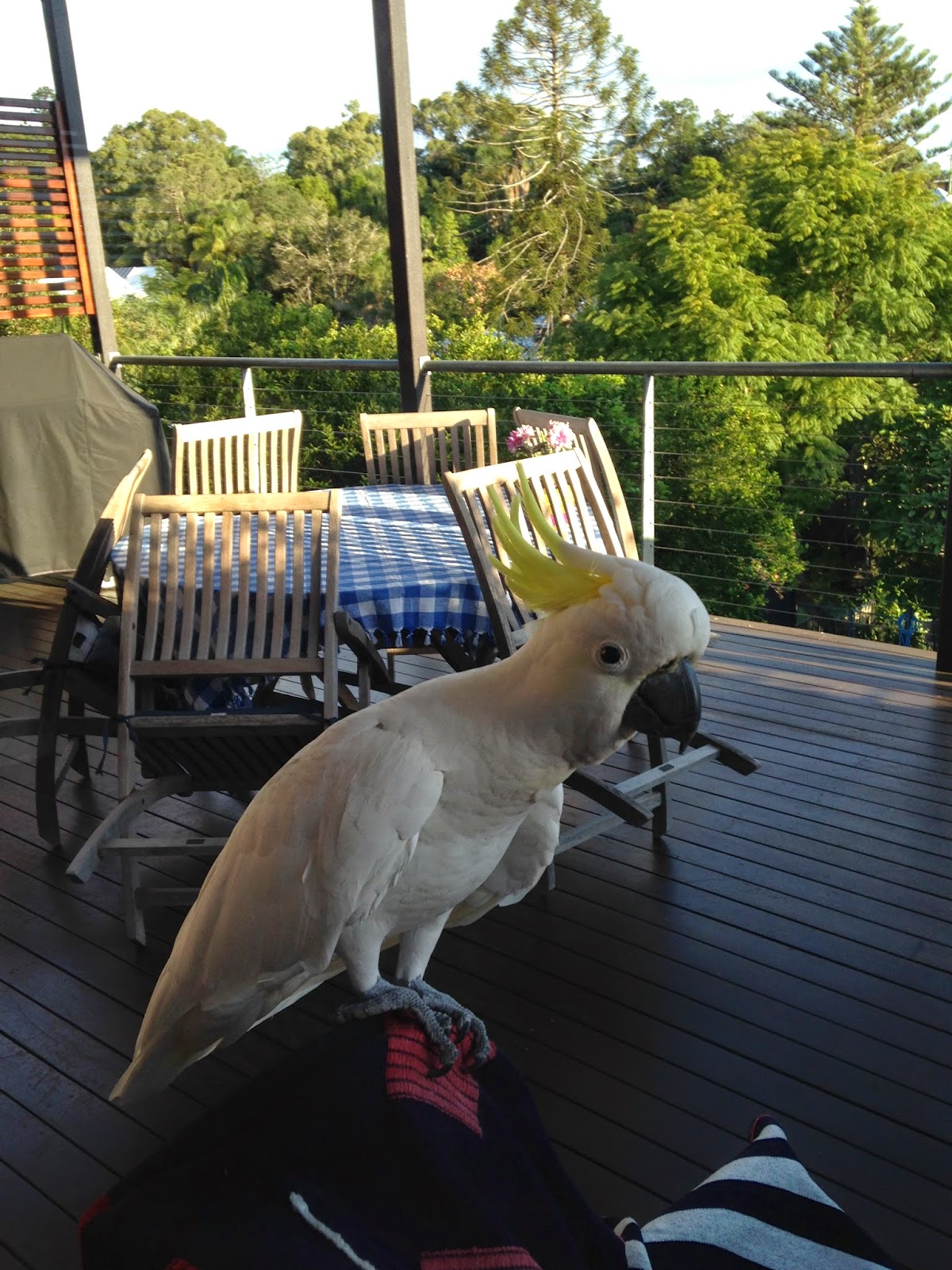
However perhaps the most frequent users of the bird table are the raucous Sulphur Crested Cockatoos. They swoop down with the most monumental raaaaak announcing they are coming to lunch. Apparently Cockatoos are not early risers ! We often get several perched on the table and we can be sitting only a few metres from them and they will  happily carry on munching the seeds, making an awful mess and then having drinks of water. I do enjoy sitting and watching them so happily share some of the pictures with you here.


More recently however I noticed that one bird that was flying in was lacking his sulphur crest and I thought perhaps this was a sign of him being in a neighbourhood squabble or like middle aged men, this is a sign that they are thinning on top. So I looked out for this one coming in, thinking perhaps it is not as resilient as some of the others. You may be interested to know that Australian birds are apparently some of the most aggressive birds in the world and have been known to destroy trees, houses and paintwork to name just a few of their achievements. Cockatoos are not only aggressive they live to a very ripe old age. That does not stop the magpies sitting in the hoop pine nearby swooping down on them and giving them a real run for their money.

When another cockatoo turned up looking as if it too had been in the wars, it lacked some of its crest but not all and its beak looked mangled I actually began to worry and on researching this and talking to a vet, a colleague of my husbands, I realised that the birds were suffering from Beak and Feather disease. Apparently they can be cured so I am heading out to the vet shop to get the right treatment for their water. So watch this space - for an update on my sick cockatoos because I am determined to get them to live to a ripe old age just like nature intended. 

Sunday, 13 July 2014

Those Greeks knew a thing or two

While wandering around in Sydney Botanical Gardens I came across this semi circle, The Henry Kendall seat, dedicated to the poet, Henry Kendall, and the winged horses carved by L Bicego in 1939. It was the highlight of my day - first because it was in my own language, so far from my origins, and secondly because it espoused thoughts and feelings which find me floating with them.


The translation of the words are : 

I walk on air 

 Contemptuous of the sun 


Just the perfect quote for this sun soaked country and what some of those early settlers had to contend with.

Monday, 7 July 2014

Sydney's Botanical gardens

We spent the better part of a whole day wandering around Sydney's Botanical Gardens and I am not sure I even took in half of it really. Its beautifully laid out with lower, middle and higher gardens and it dates backs to the first settlers and their need to put in some green spaces not because they thought that they were a priority so much as that they needed to experiment almost immediately with what they could culitvate on this vast continent. They were rudely surprised and it took a lot longer than they had anticipated to find crops that grew well here.
The gardens  are spread over some 30 hectares really at the heart of down town Sydney. You can enter from various gates, one quite low down near Circular Quay and the Governor's Mansion. Several higher up closer to St Mary's Cathedral and the State library. It is easy to navigate with helpful maps at the gates. While we were there we also took in two exhibitions which are worth seeing in Botanica, and a small exhibiting hall in Lion's Gate with the most stunning painting of plants and the other of pencil drawings of what I like to call the secret life of plants, the fronds, the stamens, the hidden orifices and intricate petals which constitute the systems by which they reproduce.

Throughout are ornate fountains, all with a history to tell of why and how they were chosen. The Levy drinking fountain,one of the few remaining drinking fountains in Sydney, the enormous fountain at the entrance and and this splendid French sculpture by Jacquemart of a huntsman and his dogs.
There are so many sections of the gardens I can only really show you some of them- the ones I particularly enjoyed. I loved the grasses in different forms, the cactus and succulents which are so extensive and successful here as well as the ferns and the bromeliads which have colourful flower stems.
 An unfolding fern frond.


A very big tree fern
A cactus of some proportions
Bromeliads with their interesting flowering spikes
My favourite succulent - the Sultan's Cap ! You can just see him wearing it.


Guided walks are offered at 10.30 am every day (11⁄2 hours), and also 1 pm Monday to Friday (1 hour) from the Garden Shop. There is always more on offer -not least one example of the Wollemi Pine, the so called Dinosaur Pine which was discovered in the Wollemi National park only in 1994. So check out the website http://www.rbgsyd.nsw.gov.au

But my favourite place of all in the botanical gardens is one for next time. 

Saturday, 28 June 2014

Sam Fullbrook - Australian Artist 1922-2004.

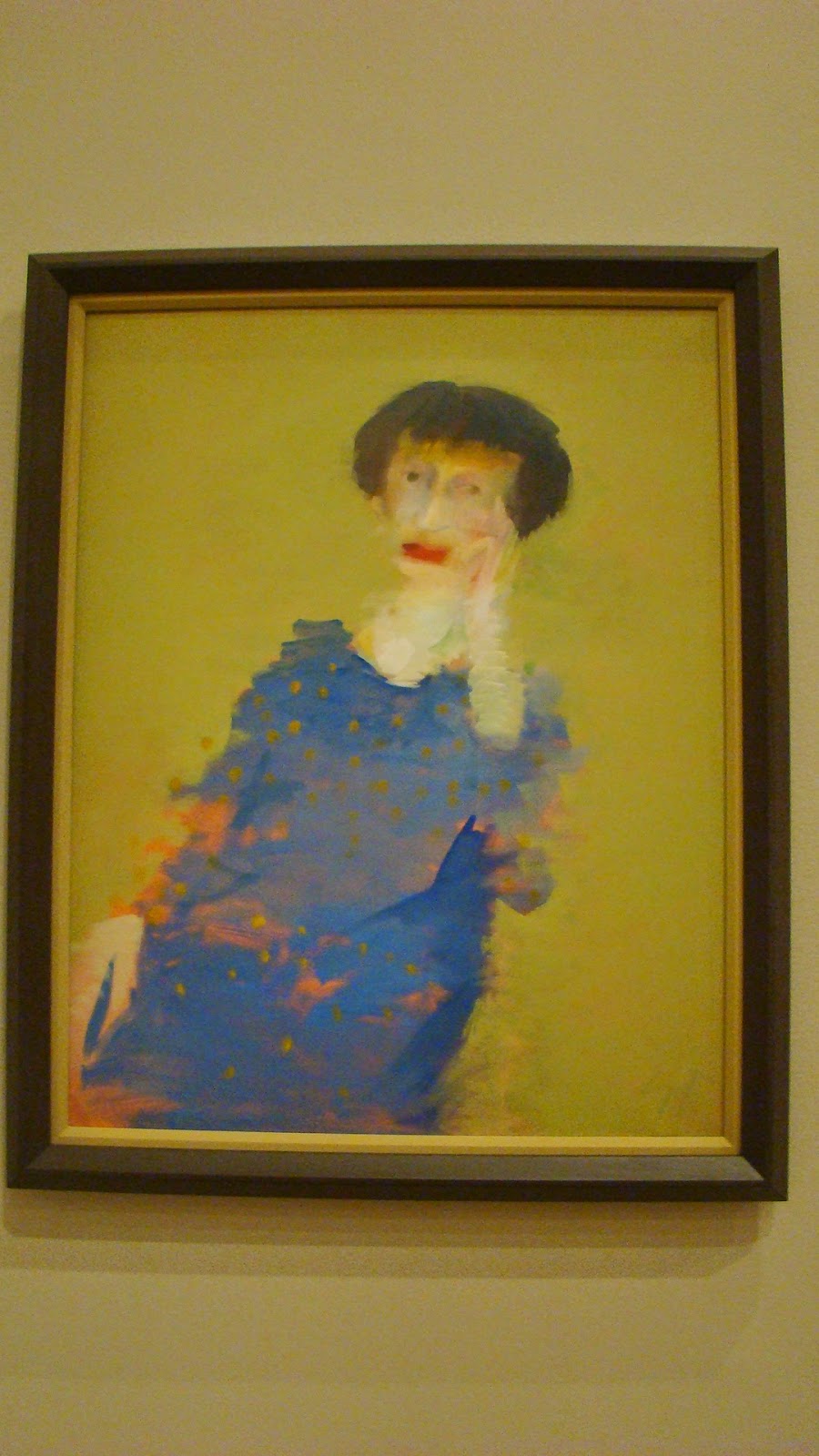
I have the chance to visit galleries and see wonderful exhibitions in this country and this is one I want to share with you though I appreciate that seeing the actual paintings instead of their pictures is a wholly different ball game. Sam Fullbook was one of Australia's finest Painters after the Second World War.  He has passed away but while he lived, he had a bit of an itinerant life and perhaps because of it or perhaps in spite of it he produced some fabulous art which I really enjoyed.He spent large parts of his life in Queensland and had studios on the coast and in Brisbane at various times in his life.  His canvases are fluid and not specific - his portraits are somewhat similar and yet I feel, like his paintings, have so much depth and substance. I look as his landscapes like the Monsoon Sky and it is all there in the brushstrokes and the large blocks, the storm, the darkness and the rain - by contrast his Sandhills on the Darling Downs is infused with almost a glowing white light which is beautiful, almost ethereal and of course so evocative of the light in Queensland.
The Monsoon Sky 
Sandhills on the Darling downs 
This apparently could be the beach and lots of people on it or it could be an ice cream cone with lots of flavours - you choose !
I loved his portraits best of all so here are some of the best - the exhibition is on until August the 10th and is on at the Queensland Gallery of Art.

 Miss Ernestina Hill 1970, perhaps one of his best known.
 The light in this face draws you to it - yet the brush strokes are really quite broad.
This is his portrait of Jacob Oberdoo or Obaju 1957-1960 when he lived up in Northern Queensland. He refused a medal of the British Empire saying that medals were for dogs . His portrait of this stockman is one of incredible dignity. Fullbrook won the Archibald Prize for Portraiture and the Wynne Prize for Landscapes and I can see why. 

Friday, 27 June 2014

Maleny

There is a charming little hilltop town called Maleny, about 90 kms north of Brisbane, which was buzzing on the long weekend. It is set among the Blackall Range on an escarpment with some wonderful views of the valley below as well as the Glass house mountains. It is full of quaint little shops and some shopping arcades and people linger and window shop to their heart's content. I think my favourite is the wood shop in the middle of the village with the most exquisite carved and polished woods and the second hand bookshop.
It used to be populated by the Nalbo and Dallambara people of the Gubbi Gubbi nation who used to hold Bunya Festivals there. Theses are enormous pines which produce the biggest cones ever.This is a picture of one I took from Wikipedia.
They  were called pines by the settlers but in fact they are of the araucaria family, like the monkey puzzle tree. These trees were sacred but also a source of food and celebrations.  Sadly the Bunyas have been cut down and the area is now known more for its dairy industry. We travelled there along beautiful rolling country side, and farms tucked away in the hills. The roads were empty - or at least that is how they felt to us- and the countryside ours for the taking. 

Tuesday, 17 June 2014

Agave attenuata

I have been walking past these enormous succulents for a while. Each time I note the flower  stem has grown even more, so this time I took my camera and captured its tumescence before it goes on the downward spiral. They extend much higher than my 153 cms and it starts with the flowers and ends up with the droopy spike. 

Looking at the plant and trying to identify it I think it is the agave attenuata - originally probably a Mexican plant. Also known as the "lions tail"- obvious innit, "the swans neck"- yup that too and "the foxtail", perhaps the least successful of the common names. It is, I am told, common as muck in Brisbane, being planted in many of of the city's flower beds. It only flowers once, and then the plant dies, but this doesnt happen before the plant reaches maturity which may be 8 to 10 years and it usually produces small new plants from side shoots. For something which is as common as muck you have to say it has presence and stature of some remark.