Hello welcome to my Blog

Mezze is widely served in the Greek and Middle eastern world. An assortment of little dishes and tasters which accompany a nice ouzo or a glass of wine. So when you read mezze moments you will have tasty snippets of life as I live it, India for four years and now Brisbane Australia, all served up with some Greek fervour and passion.

Search This Blog

Tuesday, 25 February 2014

Wild Brisbane Companions

You might be thinking of wild young things in the infamous Fortitude Valley but actually the ones I am going to talk about are no further than my back garden. This was a topic discussed by Gillian Paxton from the University of Queensland whose subject was Wild Brisbane Companions- living with Common Native Animals.
I am picking up her theme because I really do feel I have a couple of wild companions who I would like to introduce you to. There are the shy ones I have blogged about before, the reptiles in my garden like the green tree snake and the carpet python.They, I have to say with a bit of relief, are not regulars but these guys are :
This is Wally the water dragon, and his offspring is also around, usually face up near the compost waiting for something to drop from the sky. We shall call him Junior as I have no idea what sex he /she might be. Junior has haunts, like any young one would do, and I can predict pretty much where to find him at any one time during the day. The best vision of junior is when he is climbing the tibouchina and sleeps on one of the far out branches. The only thing that gives him away is his tail which hangs down from the main branch.

Junior waiting for Godot 

This is Junior heading to Bed.

As he settles down for the night the Possum and its baby come romping out and often dance loud dances on my roof and eat the tender shoots of my passion fruit plants but I can forgive them, if I was a possum those would be my delicacies too. They live in the neighbour's roof - a good use of roof space!


And finally as I walk out the house I am more than likely to meet one of these who have become so adapted to the city environment. Brush Turkeys have been called Birds behaving Badly because they have adapted really well to living in cities and whereas in the 1930s there were fears of extinction, their populations are now thriving. They annoy home owners as they often dig up seeds and plants in their attempts to build up their own little nests. 

So you can see how these wild companions have found their own place in the city. And they cross the road like you and me looking out for traffic as they go. There is space enough for all of us.

Friday, 21 February 2014

Batty Boat cruises


Batty Boat cruises.

You hear the name of this Cruise and you really do wonder what might be behind it. This is one of the rare instances when a name in Australian is extended. This is a cruise about Bats. We went on it because we see bats flying past our deck every night – at around dusk as the light is fading they all fly out looking for their dinner while I am busy in the kitchen cooking mine. 

They are also called flying foxes, I suppose because their sweet little faces do resemble foxes. Bats are one of these creatures that suffer from a terrible reputation. From disease spreading to rabies carrying they seem to attract the worst.

However they are very vital to the environment and deserve our protection if not our cuddles. They are mammals of course and produce babies like us. There are big ones and little ones. We mainly see the big ones flying around but the small ones eat insects and the bigger ones, which are vegetarian, are very important for seed dispersal and pollination. Here is a picture of one rescued in our garden in India.


One of the reasons I am writing about this is because when the boat cruises started back in 1984 there were over 160,000 bats flying out every night or near those numbers from Indooroopilly Island. But when we were there the other day the numbers were way, way down and according to the organisers they are falling drastically every year. Part of it is changing habitats and this is a huge issue in areas like Brisbane where the city is expanding so quickly and where normally remote habitats come within the city boundaries.We travelled from Mowbray Park down the Brisbane river about 22 kms away from the sea. While on the cruise we listened to some interesting commentary about bats and were also able to see some baby orphaned bats which were very cute. 

Picture taken from Animals of Australia website 

The cruises are run by the Wildlife Preservation of Queensland Brisbane Branch and I suppose the reason I am writing about this is because I understand what a hard task they have on their hands. So if you are interested in becoming a member or a volunteer or going to their really interesting talks then go to http://www.wildlife.org.au and check out the details. 

In their newsletter I came across a very interesting article entitled "Wild Brisbane Companions" and I will blog about this soon. 


Monday, 17 February 2014

Beat this

Two days ago, before the weekend there was nothing between me and my post box. Look what has been built in that short time - a fine pyramid of silk threads, like the glass pyramid in the Louvre in Paris, but one which sways in the wind, catches the rays and plays away. 

Postman usually have to negotiate cats and dogs. In Australia its spiders !

Friday, 14 February 2014

Bus etiquette


Is there such a thing ? In a short answer very much so, and it is alive and well in Brisbane. Why this should be so I am not entirely sure, but overhearing one young man as he was ready to get on the bus has given me some answers.

This is my preferred mode of transport. I have a Go card which I touch on and off. The bus service is expansive, reasonably frequent and reliable but nowhere have I experienced old fashioned manners as I have here in Brisbane.It may have a lot to do with its roots as a big country town. The transport system started in 1885 with horse trams and then went into electric trolley buses in the 1950s before expanding to the present day CNG run buses. 

It does not matter how long you have been waiting for a bus, when one comes along you see that young people will stand aside and allow older people to get on first, followed by mums and babes.I watched as one man stood aside with his mate - his mate moaned about having to wait like this and the young man said to him:

"Mate my grandmother would kill me if I didn't do this !"

I boarded the bus before them and turned to them and said "I love the fact that you do this !"

Would you consider greeting and thanking the bus driver in New York or London ? It would seem silly but here it is the norm.

I get on and and say "Good morning" or "Good day" and more often then not the bus driver, (a lot of them women by the way) will say "Good day" and quite a few will say "Isn't it a beautiful day!" as if it is a rarity in Brisbane which cracks me up each time.

People leave the bus and wave and verbally thank the driver with a loud "Thank you driver !"I do it without fail but again what is surprising is that often they will answer back and say "You have a good day", "take care", "cheers !"

On a couple of occasions younger people have given up seats for me ( Horrors to that of course, do I really look that old?) In fairness though, there are usually enough seats, except around school time when the kids get on in their very old fashioned uniforms styled on UK public schools and they will not sit down unless they have asked anyone standing if they want to sit down first. All the buses are disabled friendly so people in wheelchairs can get on and off without any issues. Free buses circulate the city like the one in the picture that you can get on and off at any stage on its route. Once on, people chat but do not talk loudly on their phones.

Did I mention the lovely and friendly conversations I have with complete strangers while waiting for a bus... 

Bus heaven - I think so.


Monday, 10 February 2014

Surprise yourself

I did. I looked through my pictures of 2013 since arriving in Australia and was very surprised to see how many I had of birds - Now you have to understand that I come from an island in the Mediterranean  where the inhabitants spend their time either catching them, hunting them, or eating them in equal abandon. And even attempts by the EU and other bodies have not managed to bring these practices to a complete stop though they are much reduced. So lets just say I did not grow up with a love for birds.
I did however marry a man who likes birds, books and taxonomy and is quick to identify and compartmentalise. Right form the start he would point out a bird and give me a name but sadly not many stuck in my brain.On safari in India, very different from those in Africa, we came to focus on the birds, and I started recognising and being able to name quite a few.  Arriving in Australia this has been taken to a whole new level. They are on our deck, in our garden, up the street, in the botanical gardens, outside our bedroom window. They are plain, gaudy, striped, spotted, bright. 
They are, to my surprise, a complete delight. 
 Rainbow lorikeets on our deck
Kookaburra in our tree
A magpie on our balcony

The beautifully coloured purple swamp hen 

 Another kookaburra  in our tree

 Australian white ibis
 Magpie Lark
 Egrets maybe ?
Noisy miners
 Crested pigeon
 Sulphur crested cockatoos
Moor hen and baby 

A twitcher in the making - who knows ? 
What has surprised you in your life lately ? 

Friday, 31 January 2014

Flesh

I have just returned from India where the issue of women's safety, equality and respect is being hotly debated, with more reported cases of gang rapes against Indian women but also western tourists, and with village chiefs suggesting punishments for women who don't tow the line. A community  leader talked about the incidence of rape being low in his area because women covered up, as opposed to other areas - clearly leaving the suggestion that womens' state of dress or undress provoke the vile, gang rapes and abuses against them.This is a place where women cannot be on the streets safely anymore, where violence is increasing against them, and where the state and the police force have done precious little so far.But actually it is not just the laws and the court system that needs changing it is the mind set of a people who have been raised to believe the boy child is the only one that matters. 

And so to Australia and to the wonderful - let me say it again - wonderful state of undress of a whole nation. I will talk only about women here to make this small, but to me, valuable comparison of how things should be. 

It is summer time here - the temperatures are pleasantly warm and occasionally hot - girls, mothers, daughters, sisters, cousins, dress in a way which shows maximum flesh - yes there is so much of it around that when I first got here it took me a while to adjust after being covered up in India. It is proudly displayed on every type of body and shape imaginable and takes on every shade under the sun from  ghostly white, to pinky white, to olive, to brown and black. It doesn't matter what colour you are nor what clothes you are ultimately not wearing. 

After years of leery stares in India, I have arrived on a continent where men go about their business as they would and do not give women a second glance no matter how much flesh she might be showing. That is not to say they don't appreciate a curvaceous body or a beautiful face or even a combination of the two - just as a woman would admire a good looking man, but there is none of that staring, the lechery which goes with prying on women and making them feel uncomfortable and ultimately not safe. I could be facetious here and say you know that old adage that some men undress you with their eyes, well in Australia I guess they cant do that as the girls do a pretty good job of it themselves ! Do not think that Australia was always as relaxed as this. Apparently in the 60s women had to wear 7.5cms of fabric at the hip of their bikinis or they could be arrested ! Think how far they have come in some 50 years. Perhaps India will show that level of change in the next 50 or so, we can only hope . But there is a serious point to this and that is I am meeting a  a society which has brought up its children to respect the sexes and to respect their freedom to express themselves. This respect has nothing to do with the colour of your skin, the cut of your clothes or your sex.And do you know, that is all there is to it. 

It is egalitarian and joyful, liberating and cool and I would happily have raised a daughter here knowing her sex would never have a negative bearing on her life, her outlook or her safety. 

Friday, 24 January 2014

Jaipur Literature Festival 2014

Its over for another year. Hard to come away and leave it all being dismantled, this year a day early, due to the heavy rain that fell in the night.Some of the venues became unusable, and had the organisers scrambling to arrange new ones on the site at the last minute.

For those who come to this for the first time, the Festival has been going since 2006. A handful of eager writers came together then and read their works at a place called Diggi Palace in the city of Jaipur. This, the 7th Festival, saw over 200,000 people go through its gates with 75,000 on Sunday the 19th of January. For India perhaps, when you think of other Festivals like the Kumb Mela these numbers may not appear that large, but for me this is the one overreaching fact that makes the Jaipur Literature Festival so special together with the basic premise on which it was founded, which is that it is free for all. 
Unlike elsewhere in this caste and class ridden society everything works on a first come first serve basis and no one can have reserved seats, or a bigger say. My friend Catherine put her finger to her lips and sushed two chatting ladies, sitting behind us, two Bollywood actresses who had come to the show. School children pour in, young people ask questions, thought provoking and complicated, the authors interact wonderfully on seemingly little rehearsal, (they are perhaps well versed in this kind of exchange) and the sessions are always on time, mesmerising and inspirational. This year I will not talk about the various sessions in great detail. My world has shifted and perhaps some of my readership so I will share with you some of the highlights.There was so much more ... I sat behind this beautiful back which I thought was worth capturing on camera and then saw her exquisite face. Just one in the crowd. 

 The makeshift venues packed to the rafters - after the rain
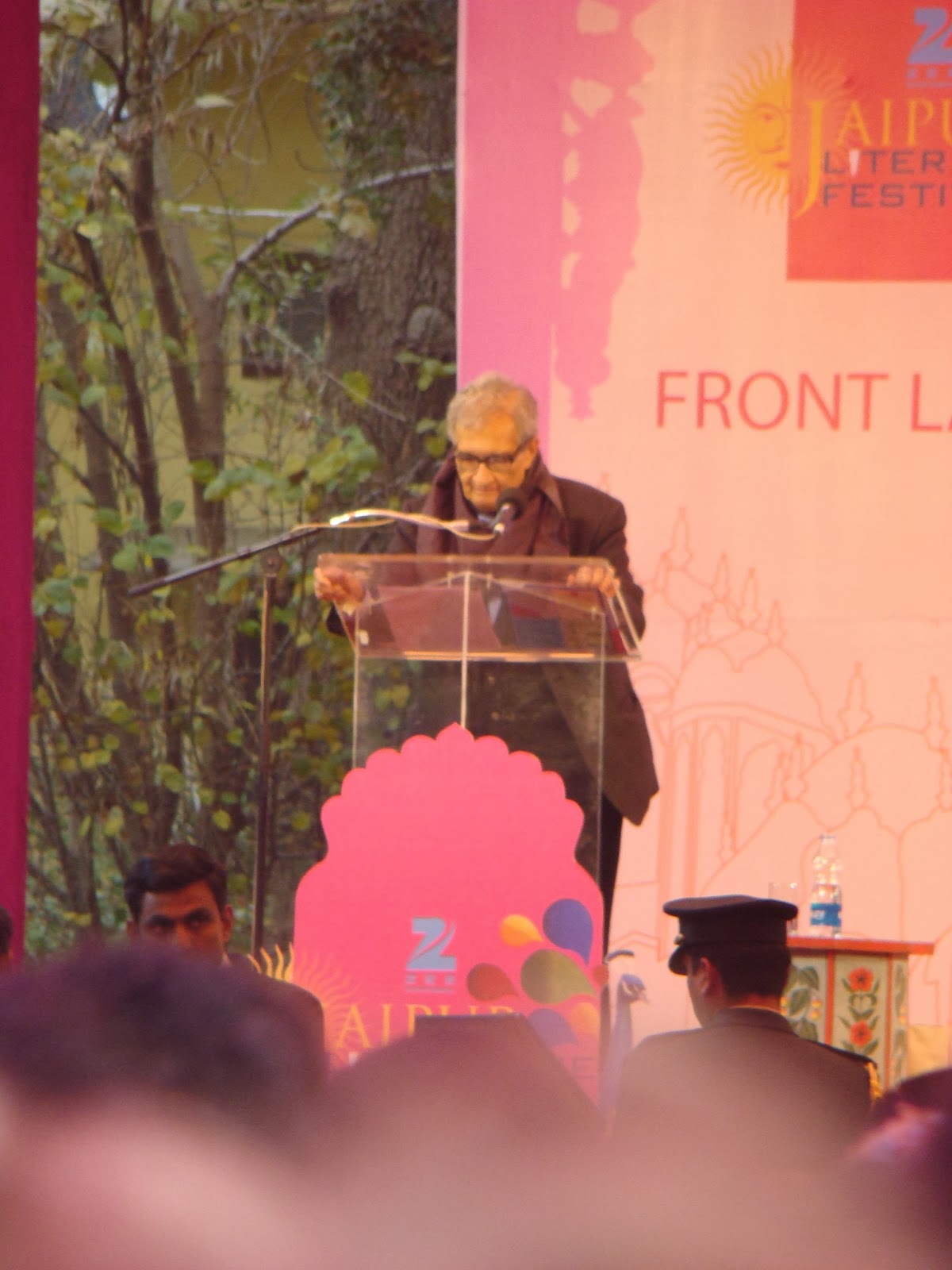
Amartya Sen, renowned professor of Economics and Philosophy came with a simple but engaging dialogue with a goddess in which he put forward his seven wishes for his country India. Things which we all wish for perhaps, but which are affirmed by someone like him. That the media is more responsive to the needs of the poor. That children have access to education and basic sanitation, including health care and clean water. That women are safe and equal in India, that the Courts are progressive and not regressive. There has been a reversal of a court case making homosexuality a criminal offence. That social media play a part in this and that we must as a consequence of these needs all read more books.
Amartya Sen on a cold morning at Diggi Palace. 
Jonathan Frantzen contemporary American Author of the "Corrections" and "Freedom" has a bit of a horror of festivals preferring solitude and dark cold places. He grew up reading lots of books and was never alone for all the characters who embraced him.
Gloria Steinem who at 79 looked great, reached out to her Indian audience and asked them to be activists for their issues, behaving as if everything does matter, no matter how big or small the action. 

Justin Cartwright and Peter Godwin on the fate of their countries, South Africa and Zimbabwe. 
Jhumpa Lahiri, telling us how she was constantly aware of her parent's sense of loss of Calcutta, growing up in America, which may have been the corner stone for her writing her stories like "The Namesake" and "Lowlands" about Bengalis and people of Indian origin. 
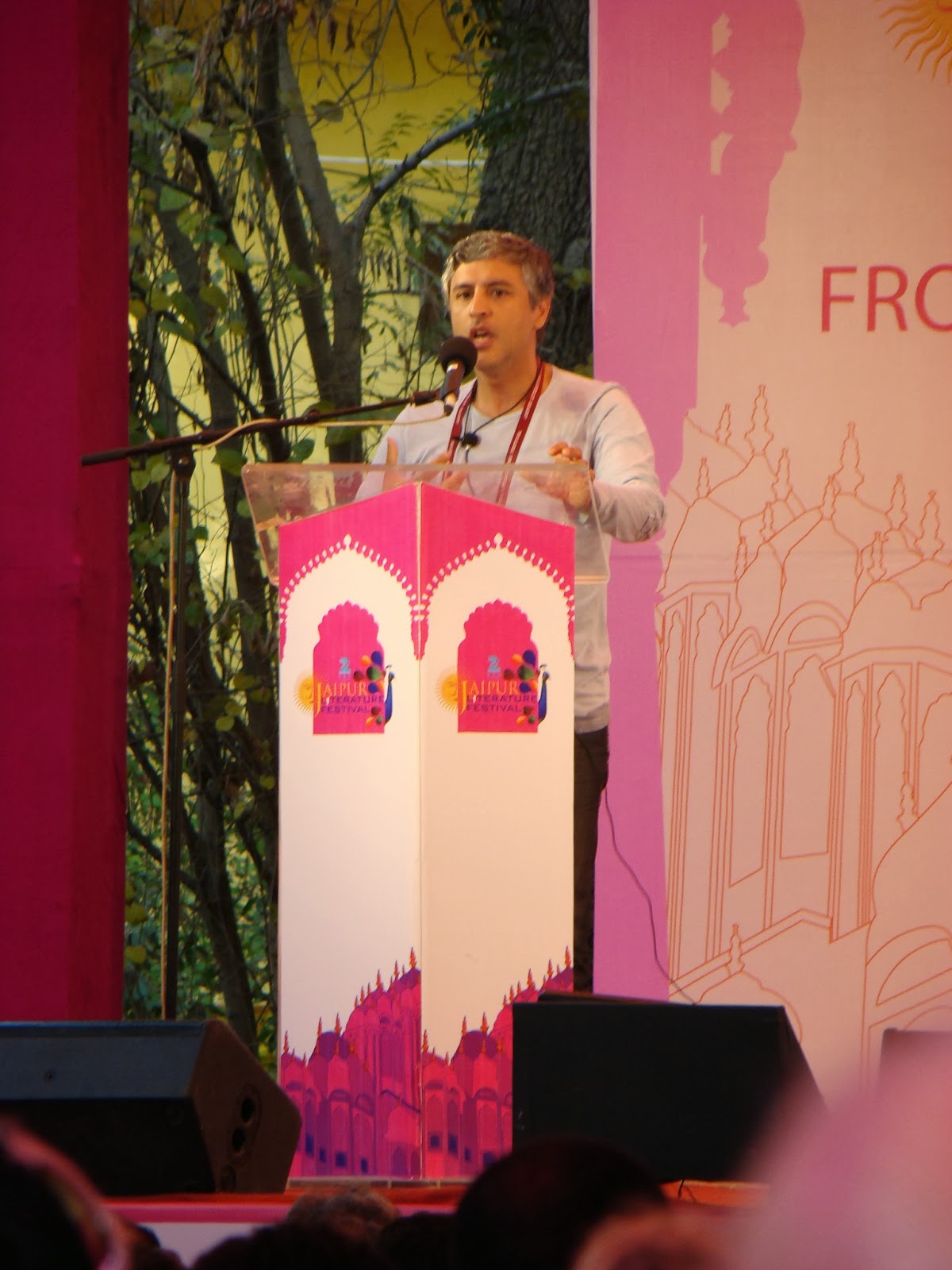
The exuberant Reza Aslan on what we actually know about Jesus. "Zealot, the life and times of Jesus of Nazareth" The equally captivating, if disturbing account by Adrian Levy of the Mumbai siege,  in his meticulously researched book "The Siege" and what the secret services get up to and even more disturbingly that they knew of the planning of the Mumbai attack and had passed the information on to the Indians. 
The astoundingly young but very accomplished Historian Maya Jasanoff talking about her book "Liberty's exiles". The loyalists to the British empire that needed to find safe havens in the British empire after the American war of Independence. 


Historians such as Anthony Beevor on war literature. He is the author of "Stalingrad", "Berlin" and the "Second World War" and David Cannadine (above)  talking about the how the British Empire was run on a shoe string budget.  Mary Beard on the Romans, Greeks and the Classics. The people's favourite Pavan Varma, diplomat now turned politician,  on whether there is an Indian way of thinking. The panel of speakers decided there wasn't but we thought there was ! 

Robyn Davidson who is based in Melbourne, talking about the Himalayas. Cheryl Strayed about her books "Wild" and "the Beautiful Things". Isabella Tree on the "Living Goddesses" of Nepal.  

A. N. Wilson whose latest biography is a "Potters Hand", a historical fiction about Josiah Wedgewood but who also wrote "Dante in Love" and "Tolstoy".I think my favourite though was Richard Holmes, a biographer of some renown whose recent book "Age of Wonder" is about what the Victorians achieved in their times, using science and skills to enhance their understanding of the world.  In a session to packed audience on the last day he recited the "Ancient Mariner" to us, telling us that Coleridge had written this seminal poem at the age of 25.His voice was captivating, the poetry rhythmical and ordered and we were all transported off on that voyage which ended so disastrously.  

 Richard Holmes reciting Coleridge.
As if all this and more was not enough to tickle our senses the nights were filed with music from sensational bands like the Sca Vengers, the Grammy award winning Malian band Tinariwen and the Rajasthani folk band, Jaipur Kawa Brass Band, together with Midival Punditz. 
My return to India was filled with the joy of seeing familiar faces, friends from Delhi, my erstwhile neighbours the Dalrymples, our old rickshaw driver who I had written about in Culturama magazine and the many characters we met over delicious lunches, standing or sitting next to us, all enjoying the offerings of what is probably the biggest literary show on earth.